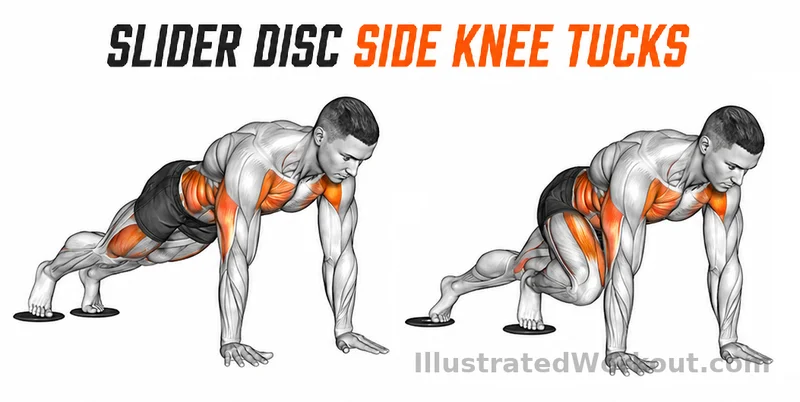
Disc Slider Side Knee Tucks
Obliques and deep abs draw both knees up and across toward one elbow as the feet slide in from a high plank, then extend back out.
Want a disc sliders core workout?
Our wizard builds one around your time, goal, and equipment in about two minutes. Free — no signup needed.
Make Me a Workout → Just did it? Track your setsObliques and deep abs draw both knees up and across toward one elbow as the feet slide in from a high plank, then extend back out.
Level: Foundation
Primary: Abs
Secondary: Quads Shoulder
Movement: Isolation
Tags: Core Stability
Type: Anaerobic Intervals (HIIT / Bootcamp / Circuit) Functional Fitness (Obstacle & Hybrid)
Equipment: Disc Sliders
Target muscles
The obliques take centre stage, contracting to draw the knees up and across toward one elbow, while the rectus abdominis flexes the trunk and the hip flexors pull the thighs in. The shoulders, chest and serratus stabilise the plank base, and the glutes and low back work to control the return as the legs slide back out to a straight plank.
How to perform
Setup
Start in a high plank with hands under the shoulders and a slider under each foot. Set the feet together and brace the abs and glutes so the body holds a firm line. Push the floor away to spread the shoulder blades and keep the hips level before the first tuck.
Execution
Slide both feet in and up toward the outside of one elbow, curling the knees to that side so the obliques on that side shorten, then extend the legs back to the full plank. Alternate to the other elbow on the next rep. Keep the shoulders stacked over the hands and avoid letting the hips pike high as the knees come in. Move under control so the discs glide quietly, exhaling as the knees tuck and inhaling as they slide back. Keep the neck neutral and the gaze just ahead of the hands throughout.
Common mistakes
- Piking the hips high to help the knees travel, which takes the obliques out of the movement.
- Twisting only at the feet while the shoulders swing, instead of drawing the knees up with the obliques.
- Letting the supporting shoulders collapse so the upper back sinks between the arms.
- Sliding the knees straight forward rather than angling them toward the elbow, missing the side-bend the drill trains.
Progressions and regressions
Regress by tucking straight toward the chest first, or by moving one leg at a time to build control. A knees-supported start shortens the lever for beginners. Progress by slowing the tempo, pausing at the top of each tuck, or elevating the feet on a low box. Adding a push-up between tucks turns it into a demanding full-body combination.
Programming notes
Use it as an oblique-focused core station, eight to twelve tucks per side or thirty to forty seconds of alternating work. It fits neatly in slider and bootcamp circuits and pairs well with anti-rotation drills for rounded trunk training. Keep the plank rigid and the pace controlled; when the hips start piking to cheat the tuck, end the set rather than grinding out compensations.