BOSU V-Sit
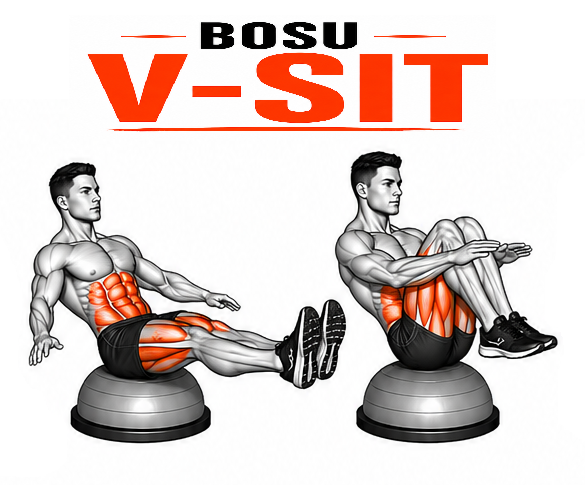
A V-sit balanced on the BOSU dome, holding the torso and legs in a V to load the entire abdominal wall under a stability challenge.
Level: Intermediate
Primary: Abs
Movement: Isolation
Tags: Balance / Stability Core Stability
Type: ISO
Equipment: Balance Trainer
Target muscles
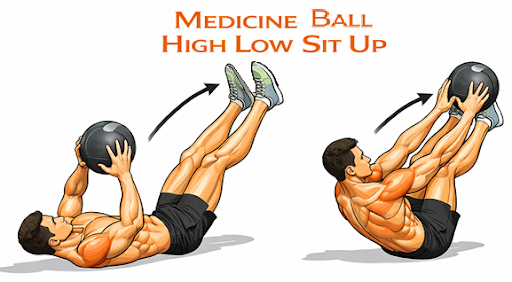
The V-sit places a large, sustained demand on the rectus abdominis, which holds the torso and legs up against gravity, while the hip flexors keep the legs elevated and the obliques and transverse abdominis stabilise the spine and balance. Perched on the rounded dome, the core must also make constant micro-corrections to stay centred, which raises the difficulty well above a floor V-sit. It is as much a balance hold as an ab exercise.
How to perform
Setup
Sit on the centre of the dome and balance on the base of your pelvis, leaning the torso back slightly with the core braced. Start with the knees bent and feet light on the floor, hands out for balance.
Execution
Lift the feet and extend the legs toward a V shape while keeping the chest tall and the spine long, balancing on the dome. Hold the V — torso and legs forming the two arms of the letter — keeping the abs tight and breathing steadily. Resist the urge to round the back or let the legs drop; the goal is a controlled, stable hold. For a rep-based version, lower and lift the legs and torso together with control rather than holding statically.
Common mistakes
- Rounding the lower back instead of holding a long, tall spine.
- Letting the legs sag and the chest collapse as the abs tire.
- Holding the breath rather than breathing through the brace.
- Relying on the hands for balance instead of the core.
Progressions and regressions
Regress by keeping the knees bent or one foot lightly down, or by doing the V-sit on the floor first. Progress by fully extending the legs, holding longer, adding small leg or arm movements, or holding a light weight at the chest.
Programming notes
Program it as core work, 2-3 sets of 15-30 second holds or 8-12 controlled reps, late in a session. The balance element means form fails before the abs are truly exhausted, so stop when the spine starts to round. It pairs well with anti-extension and rotational core work for complete trunk training.