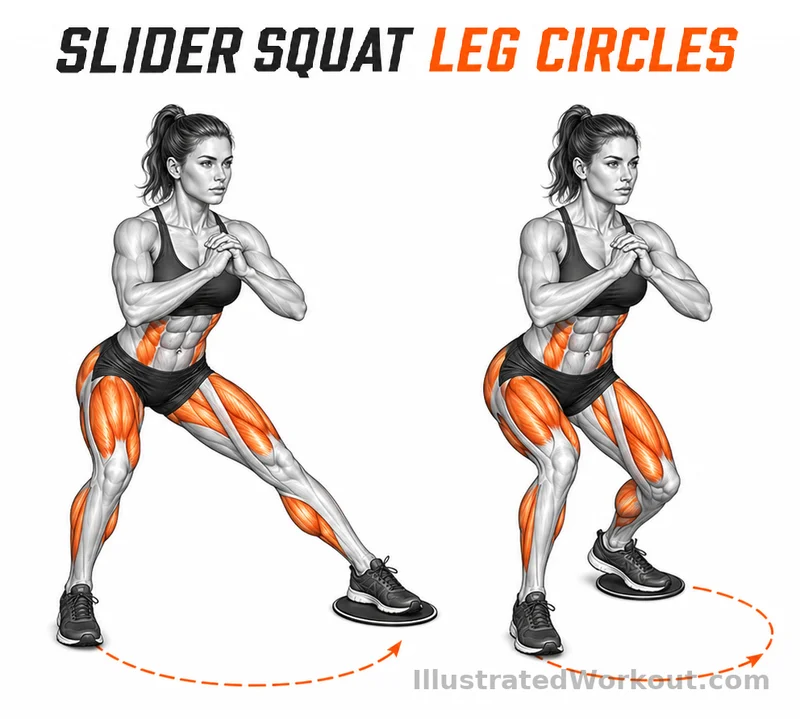
Disc Slider Squat Leg Circles
Tracing slow circles with one gliding foot turns a plank into an anti-rotation drill for the abs and deep hip stabilizers.
Want a disc sliders core workout?
Our wizard builds one around your time, goal, and equipment in about two minutes. Free — no signup needed.
Make Me a Workout → Just did it? Track your setsTracing slow circles with one gliding foot turns a plank into an anti-rotation drill for the abs and deep hip stabilizers.
Level: Foundation
Primary: Abs
Secondary: Glutes Quads
Movement: Isolation
Tags: Core Stability
Type: Functional Fitness (Obstacle & Hybrid)
Equipment: Disc Sliders
Target muscles
Controlling a circling leg from a plank turns the abs and obliques into the primary workers, bracing to keep the hips square while one foot traces its arc. The hip flexors, glutes and adductors of the moving leg guide the circle, and the shoulders and serratus hold the plank base steady against the constantly shifting point of contact on the floor.
How to perform
Setup
Begin in a high plank with hands under the shoulders and a slider under one foot; the other foot stays planted for support. Brace the abs and squeeze the glutes so the pelvis stays level. Set the shoulders down and push the floor away to build a stable upper-body platform before the leg starts to move.
Execution
Keeping the plank rigid, slide the loaded foot out and trace a slow, controlled circle on the floor, moving through the front, side and back of the arc before reversing direction. Let the abs and obliques resist the pull as the leg travels, holding the hips square and level the whole time. Keep the supporting shoulder stacked and the neck long. Breathe steadily and move only as wide as you can hold the pelvis still. Complete the circles in both directions, then switch the slider to the other foot.
Common mistakes
- Letting the hips rotate or dip to follow the circling leg instead of bracing the core to hold them square.
- Making the circle so wide that the pelvis tilts and the plank breaks down.
- Rushing the arc so momentum, not the core, controls the leg.
- Letting the supporting shoulder collapse so the upper back sinks between the arms.
Progressions and regressions
Regress by tracing smaller circles or by sliding the foot out and back in a straight line first to build control. A knees-supported plank shortens the lever for beginners. Progress by widening the arc, slowing the tempo, or lifting the supporting foot's heel for less stability. Performing the circles with the non-working leg raised turns it into a much harder anti-rotation challenge.
Programming notes
Use it as a core-stability station in a slider circuit, six to ten circles per direction on each leg or thirty seconds of slow tracing. It trains the abs to resist rotation through a long moving lever, complementing static planks. Keep the hips square and the pace controlled; when the pelvis starts to tilt to chase the leg, shrink the circle rather than reinforcing a rotating plank.