L-Sits
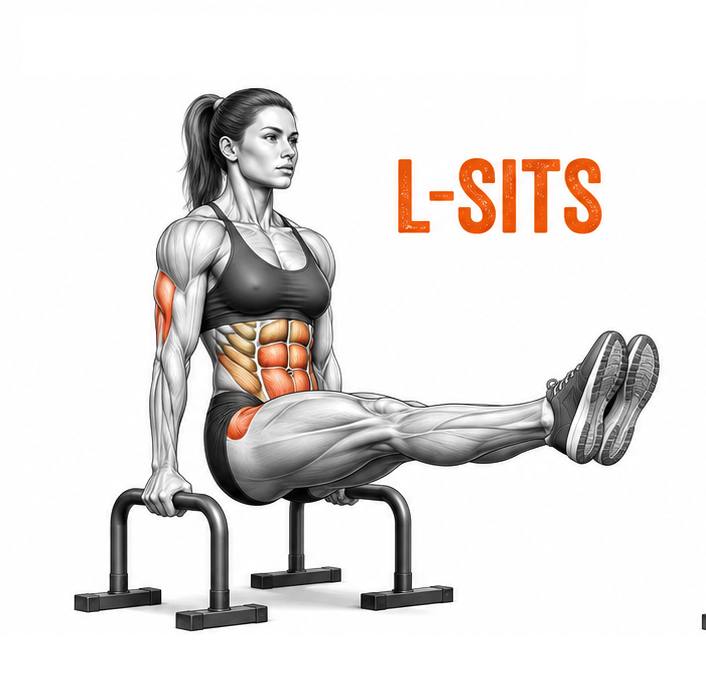
A demanding gymnastics hold supporting the whole body on locked arms with the legs raised straight out front, forming a rigid L.
Level: Advanced
Primary: Abs
Secondary: Quads Triceps
Movement: Isolation
Tags: Core Stability
Type: ISO
Equipment: Body Weight
Target muscles
The hip flexors and rectus abdominis fire intensely to hold the legs out at ninety degrees against gravity, while the quads stay locked to keep the legs straight. Supporting the bodyweight on straight arms loads the triceps, the shoulders and the lats hard, and the serratus anterior works to depress the shoulders and keep them from shrugging. It is a full-body tension hold that exposes any weakness in the compression strength of the core.
How to perform
Setup
Sit on the floor between two low parallettes, dip bars or sturdy blocks, hands gripping just outside the hips. Straighten the arms and depress the shoulders down hard, pushing the floor or bars away so the hips lift clear. Point the toes and pre-brace the abs.
Execution
Press down through straight arms to lift the seat off the ground, then raise the straight legs until they are parallel to the floor, forming an L with the torso. Keep the arms locked, the shoulders pressed down and away from the ears, and the chest tall. Squeeze the quads to keep the knees straight and actively pull the thighs up with the hip flexors. Hold the position for time, breathing in short controlled breaths. The whole body should feel rigid and braced; the moment the legs sag or the shoulders shrug, the set is finished.
Common mistakes
- Letting the shoulders shrug up to the ears instead of actively depressing them down.
- Bending the knees to cheat the leg height rather than holding them straight at parallel.
- Rounding hard and collapsing the chest instead of holding a tall, supported torso.
- Bending the arms, which removes the straight-arm support strength the hold is built on.
Progressions and regressions
Regress to a tuck L-sit with the knees pulled to the chest, then a single-leg-extended version, before holding both legs straight. Foot-supported holds on the floor and hanging knee raises build the underlying compression strength. Progress by extending the hold time, raising the legs above parallel toward a V-sit, or moving from parallettes to rings.
Programming notes
Program it as a skill and core-strength piece, several sets of five to twenty second holds, accumulating total time rather than grinding one long set. Train it fresh, early in a session, because it demands maximal tension and clean shoulder position. It is an advanced hold, so build the tuck and single-leg progressions first; rushing to the full L tends to ingrain shrugged, bent-knee compensations.