Planks Up Downs
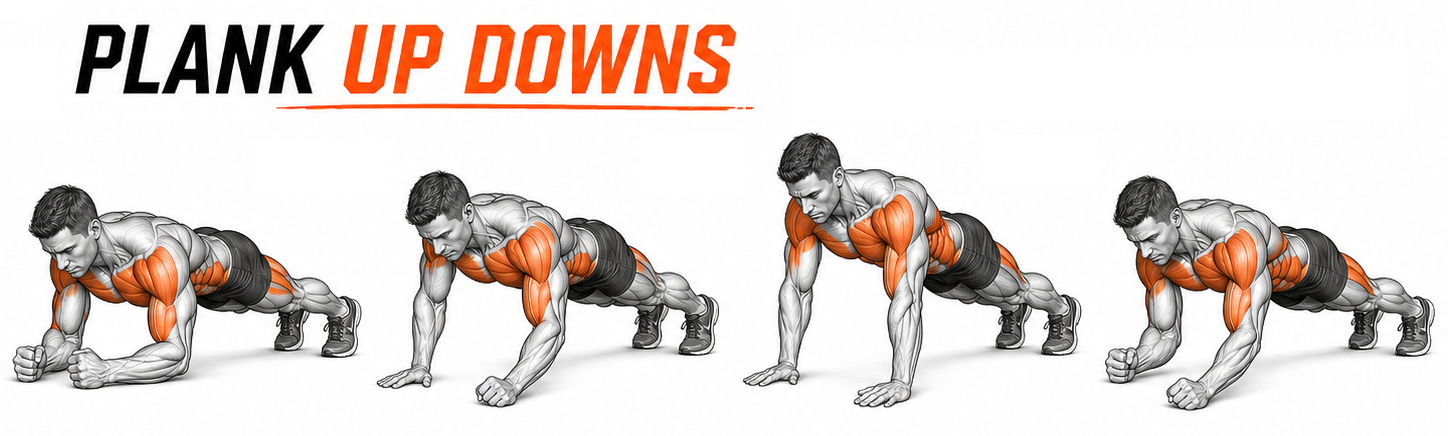
A plank walk-up that lowers from the hands to the forearms and presses back up, taxing the core to stay square while the triceps drive each rep.
Level: Foundation
Primary: Abs
Secondary: Shoulder Triceps
Movement: Isolation
Tags: Core Stability
Type: Anaerobic Intervals (HIIT / Bootcamp / Circuit) Functional Fitness (Obstacle & Hybrid)
Equipment: Body Weight
Target muscles
The rectus abdominis and obliques work overtime to keep the hips from rocking side to side as each arm moves, which is the core's anti-rotation job under a shifting base. The triceps, shoulders and chest drive the press from the forearms back up to the hands, and the serratus anterior helps control the transition. It blends core stability with a meaningful pressing-endurance demand for the arms and shoulders.
How to perform
Setup
Begin in a high plank with the hands under the shoulders, feet about hip-width for stability, abs braced and hips level. The slightly wider stance gives you a steadier base for the arm-by-arm transitions.
Execution
Lower one arm to its forearm, then the other, so you settle into a forearm plank, then press back up one arm at a time to the high plank — a continuous up-down walking motion. The crucial cue is to keep the hips square and level the whole time; resist the urge to swing the pelvis toward whichever arm is moving. Alternate which arm leads each cycle so you train both sides evenly. Keep the abs braced and the glutes tight so the body moves as one rigid unit, and breathe in a steady rhythm rather than holding your breath through the press.
Common mistakes
- Letting the hips rock side to side as each arm moves instead of keeping the pelvis square.
- Always leading with the same arm, which builds a side-to-side imbalance over time.
- Letting the hips sag or pike during the transitions instead of holding the plank line.
- Spreading the feet so wide that it removes the core challenge the movement is meant to deliver.
Progressions and regressions
Regress by performing the up-downs from the knees, or by widening the feet for more stability, until the hips stay quiet. Progress by narrowing the foot stance, slowing the tempo, or adding a push-up at the top of each cycle. Performing them with the feet on a slick surface or elevated raises the core and pressing demand considerably.
Programming notes
Program it as core and pressing-endurance work or a circuit station, three sets of eight to twelve cycles or thirty to forty seconds of continuous reps. It pairs core stability with triceps and shoulder endurance, so it fits functional circuits and bootcamp formats. Alternate the lead arm each rep and stop when the hips start swinging, since the anti-rotation control is the whole point.