Barbell Rollout
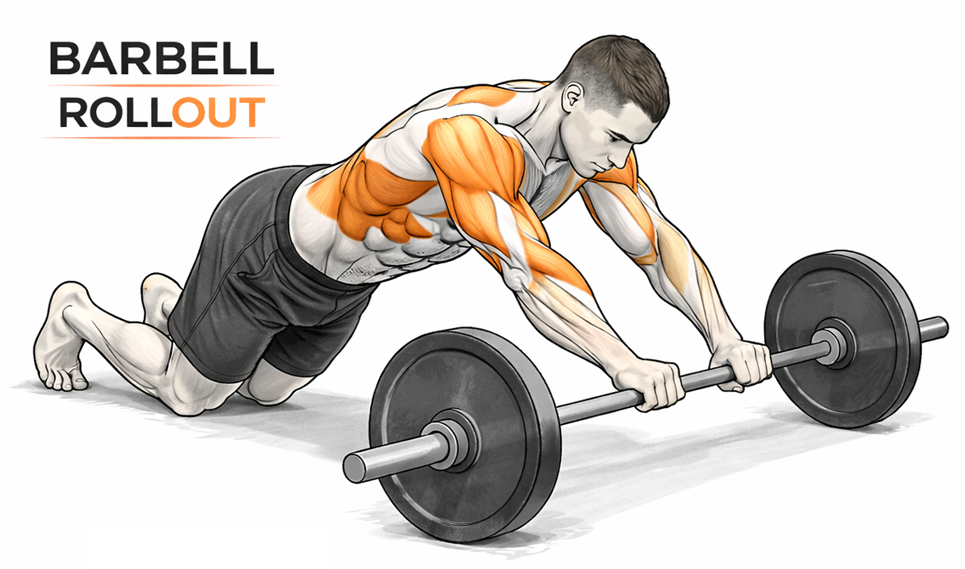
Kneeling rollout with a barbell as the wheel — extreme anti-extension training for the rectus abdominis and the entire trunk.
Level: Intermediate
Primary: Abs
Movement: Isolation
Tags: Core Stability
Type: Strength (Weight Lifting)
Equipment: Barbell
Sports: Football Rugby Track and Field
Target muscles
The rectus abdominis is the prime mover here, working concentrically to flex the spine on the way back in and isometrically to resist extension at the bottom. The obliques and transverse abdominis brace continuously to keep the trunk from collapsing into the lumbar spine. The lats fire surprisingly hard — they're working both as glenohumeral extensors and as anti-extension stabilizers through the shoulder. The serratus anterior holds the scapulae against the rib cage. Done well, the rollout teaches the trunk to resist extension under load, which is exactly what carries over to heavy squats, deadlifts, and overhead pressing.
How to perform
Setup
Load a barbell with two 10-pound plates per side (the smaller-diameter plates roll cleanly). Kneel behind the bar, hands gripping the bar just outside shoulder-width, knees on a pad, feet either flat on the floor behind you or with toes tucked under. Hips stacked over the knees. Brace the trunk hard — squeeze the abs as if bracing for a punch, exhale fully, and hold that brace through the full set.
Execution
Roll the bar away from you by extending the hips and shoulders together. Keep the hips moving with the bar — don't let them stay back while only the shoulders extend, or you're cheating yourself out of the eccentric. Go only as far as you can while keeping the lower back from sagging into extension. For most lifters that's an inch or two short of full extension; for very strong trunks, the chest can come close to the floor. Reverse by pulling the bar back toward you with the lats and contracting the abs to fold back to the start. Slow and controlled both directions.
Common mistakes
- Letting the lower back sag at the bottom. The instant you feel the back arch, you've gone too far. Stop short and earn the range over weeks.
- Pushing the hips back as you roll the bar out, which converts the lift into a child's-pose stretch. The hips travel with the bar.
- Pulling with the arms instead of contracting the abs to return. The shoulders are stabilizers, not prime movers — the abs do the work.
- Holding the breath through the entire set. Exhale on the way out, inhale near the top — breathing keeps the brace honest.
- Using an ab wheel-style rapid pace. The point is time under tension; slow it down.
Progressions and regressions
Regress to plank holds (especially long-lever planks with the arms extended forward) until you can hold a clean plank for sixty seconds. From there, partial rollouts (a third of the range) with rapid progression to two-thirds. To progress, work from the toes (standing rollout — extremely difficult), or load a small weight on a back belt. The ab wheel rollout is a near-identical sister exercise and may roll more smoothly for some lifters.
Programming notes
Excellent trunk finisher after compound lifts: 3-4 sets of 6-12 reps, two or three times a week. Most lifters benefit more from quality than quantity — eight clean reps beat fifteen sloppy ones every time. Don't program right before a heavy squat or deadlift session — fried trunk muscles cost you bracing strength under the bar. Pair with anti-rotation work (Pallof presses) and anti-lateral-flexion work (suitcase carries) for a complete trunk program.