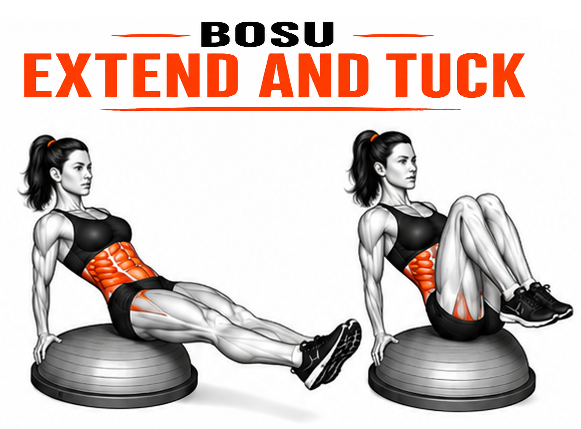
BOSU Extend and Tuck
A dynamic V-tuck on the BOSU dome that trains the rectus abdominis and hip flexors while the unstable base sharpens balance and control.
Level: Intermediate
Primary: Abs
Secondary: Quads
Movement: Isolation
Tags: Balance / Stability
Type: Functional Fitness (Obstacle & Hybrid) Strength (Weight Lifting)
Equipment: Balance Trainer
Target muscles
The rectus abdominis is the prime mover, flexing the spine to draw your ribcage toward your pelvis as you tuck. The hip flexors — chiefly the rectus femoris and iliopsoas — pull the knees in and then resist gravity as you extend the legs away. Throughout, the transverse abdominis and obliques brace hard against the wobble of the dome, working isometrically to keep the trunk square and stop you tipping off the side. The result is a core drill that trains dynamic spinal flexion and deep anti-tip stability in the same rep.
How to perform
Setup
Sit on the centre of the BOSU with your hips planted just behind the peak of the dome. Lean your torso back to roughly forty-five degrees and lift your feet so you balance on your sit bones, knees bent and shins parallel to the floor. Brace your abs, rest your hands lightly on the dome or float them at your sides for more challenge, and settle into a stable point before the first rep.
Execution
Exhale and draw your knees toward your chest while curling your ribcage down to meet them, shortening into a tight tuck. Squeeze for a beat at the top. Then inhale and reverse smoothly — extend both legs out long and low as your torso lowers back, reaching a fully stretched hollow position without letting your feet touch the floor or your lower back peel off the dome. Move at a deliberate tempo: the unstable base punishes momentum, so own each tuck and each extension rather than swinging between them. Keep breathing and keep the dome quiet underneath you.
Common mistakes
- Swinging the legs with momentum instead of controlling the extension, which lets the hip flexors take over and unloads the abs.
- Letting the lower back arch and lose contact at full extension, trading core tension for a bigger but unsafe range.
- Holding the breath and bracing rigidly, so balance corrections come from flailing limbs rather than a stable, breathing trunk.
- Rushing reps and bouncing out of the tuck, which turns a control drill into a rocking motion the dome only amplifies.
Progressions and regressions
Regress by keeping the heels lightly grazing the floor between reps, or by taking the same tuck-and-extend to the flat floor until the balance demand settles. Tucking only to a half-extension shortens the lever and drops the load. Progress by reaching the arms overhead as the legs extend long, which lengthens the lever and spikes the demand on the rectus abdominis, or by pinching a light medicine ball between the hands. Pausing two seconds in the fully extended hollow position before each tuck raises the stability cost further still.
Programming notes
Slot this in as core accessory work toward the end of a session, after the heavy compound lifts that need a fresh nervous system. Two to three sets of ten to fifteen controlled reps is plenty; the balance element makes sloppy high-rep grinding counterproductive, so stop while every rep still looks clean. It pairs naturally with an anti-extension hold such as a plank or dead bug to cover both the dynamic-flexion and the bracing roles of the trunk. Skip it on days when heavy hip-flexor work has already cooked the core.