Plank Leg Ups
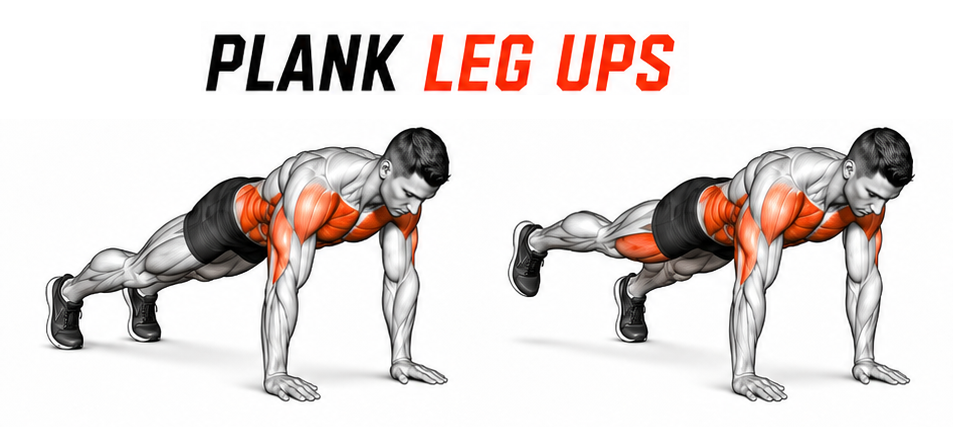
A plank with alternating straight-leg lifts into hip extension, forcing the core to resist rotation while one leg lifts off the floor.
Level: Foundation
Primary: Abs
Secondary: Glutes
Movement: Isolation
Tags: Anti-Rotation Core Stability
Type: Functional Fitness (Obstacle & Hybrid) ISO
Equipment: Body Weight
Target muscles
The whole anterior core works to hold the plank, but the standout demand is anti-rotation: as one leg lifts, the rectus abdominis and obliques fight to stop the pelvis from tilting or twisting toward the supporting side. The gluteus maximus of the lifting leg drives the hip into extension, the hamstrings assist, and the shoulders and serratus stabilise the top of the plank. It trains core stability and glute activation in one position.
How to perform
Setup
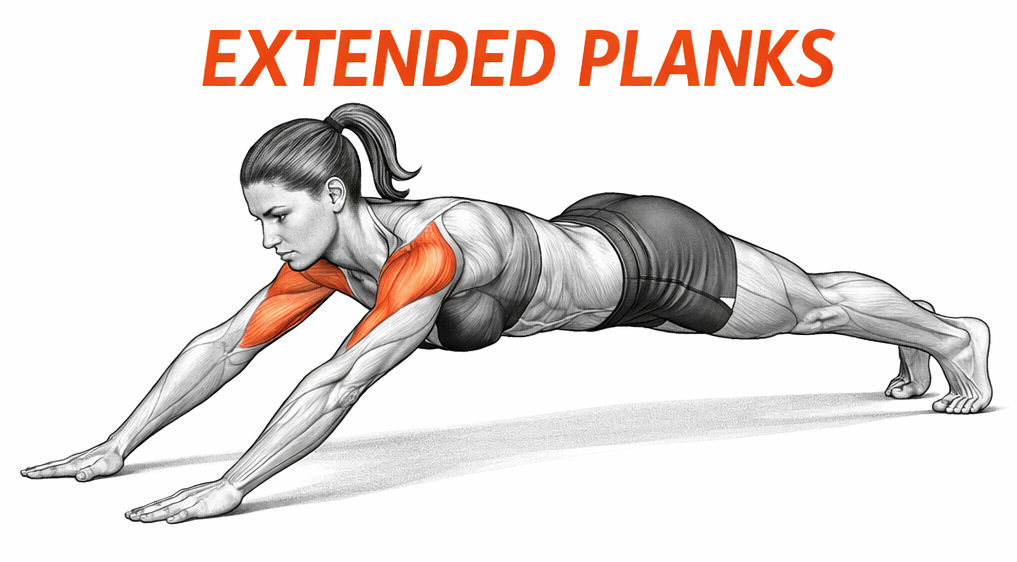
Set up in a forearm or high plank with the feet hip-width, the body in one straight line, abs braced and glutes squeezed. Set the hips level and the shoulders stacked over the support point before lifting a leg.
Execution
Keeping the plank rigid and the hips square to the floor, lift one straight leg a few inches into hip extension by squeezing that glute, then lower it under control and repeat with the other leg. The key is that the hips must not rotate or hike as the leg rises — the core resists the twist while only the leg moves. Keep the lifted leg straight and the toe pointed, and avoid letting the lower back arch to gain height. Move slowly and deliberately, pausing briefly at the top of each lift to feel the glute engage, and keep breathing throughout the set.
Common mistakes
- Letting the hips rotate or hike toward the supporting side as the leg lifts, which abandons the anti-rotation work.
- Arching the lower back to lift the leg higher instead of using glute extension within a small range.
- Letting the hips sag toward the floor once attention shifts to the leg.
- Swinging the leg up quickly with momentum rather than lifting it under control.
Progressions and regressions
Regress by lifting the leg a smaller distance, performing it from the knees, or holding a static plank until the base is solid. Progress by adding an ankle weight, holding each lift for a two-second pause, or extending the opposite arm at the same time for a bird-dog-style cross-body challenge. Slowing the tempo raises the stability demand further.
Programming notes
Program it as core stability and glute-activation work, three sets of eight to twelve lifts per leg or thirty to forty seconds of alternating reps. It fits a warm-up to switch on the glutes and core, or a circuit as low-impact core work. Keep the hips dead level and the range modest; the value lies in resisting rotation, not in how high the leg travels.