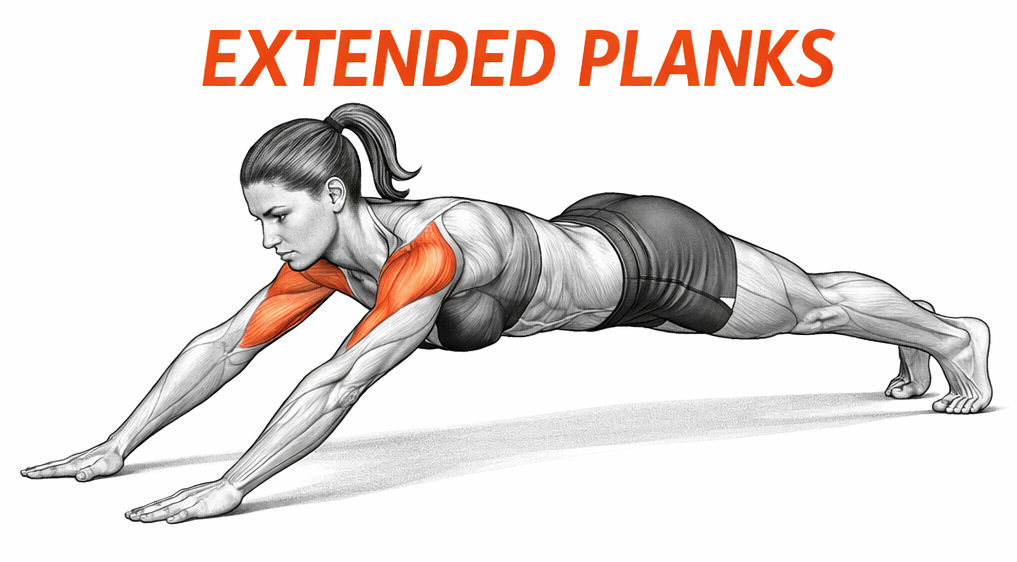
Extended Planks
Forearm plank with elbows pushed forward of the shoulders — lengthens the lever for brutally increased core demand.
Level: Foundation
Primary: Abs
Movement: Isolation
Tags: Core Stability
Type: ISO
Equipment: Body Weight
Sports: Gymnastics MMA Swimming
Target muscles
The rectus abdominis works isometrically against the increased lever. The obliques and transverse abdominis brace continuously. The serratus anterior and lats hold the scapulae stable in the extended position. The glutes and quads contribute to keeping the body line straight. The longer the lever (the further the elbows are forward), the more the trunk has to fight gravity — making this one of the most demanding plank variations available.
How to perform
Setup
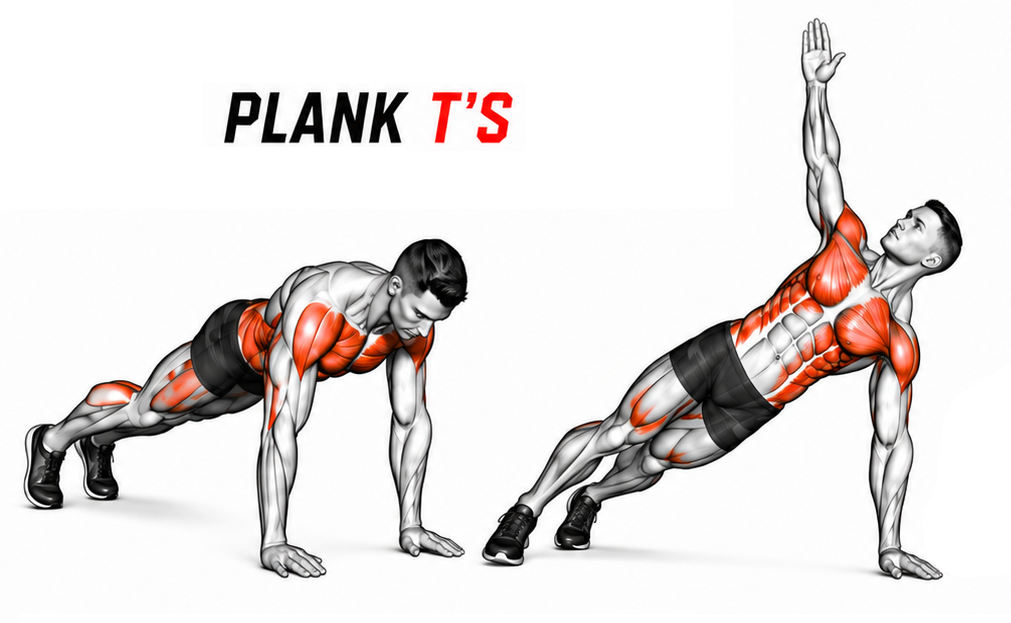
Set up in a standard forearm plank — body in a straight line, forearms on the floor, feet hip-width apart. Then walk the elbows forward of the shoulders by 6-12 inches, lengthening the lever between hands and feet. Squeeze the glutes and quads hard. Trunk braced violently.
Execution
Hold the position. The body stays in a flat line — no sagging hips, no piked-up butt. The eyes look forward, not down. Breathe in slow controlled cycles. Hold for the prescribed time. The set ends when form breaks — the moment the hips sag, you're done.
Common mistakes
- Hips sagging. The instant they drop, the set is over.
- Holding the breath. Breathe in cycles.
- Going to a too-extended position too soon. Build into the length over weeks.
- Lifting the head or tucking the chin. Neutral neck.
- Resting on the elbows alone without bracing the trunk.
Progressions and regressions
Regress to a standard forearm plank until you can hold 90 seconds. Then walk the elbows out an inch at a time as your strength allows. To progress, increase the elbow extension, add a weighted vest, or work pause planks with shoulder taps.
Programming notes
Excellent advanced trunk work. 3 sets of 30-60 seconds, two or three times a week. Pair with rollouts and hanging leg raises for a complete trunk program.