Plank T's
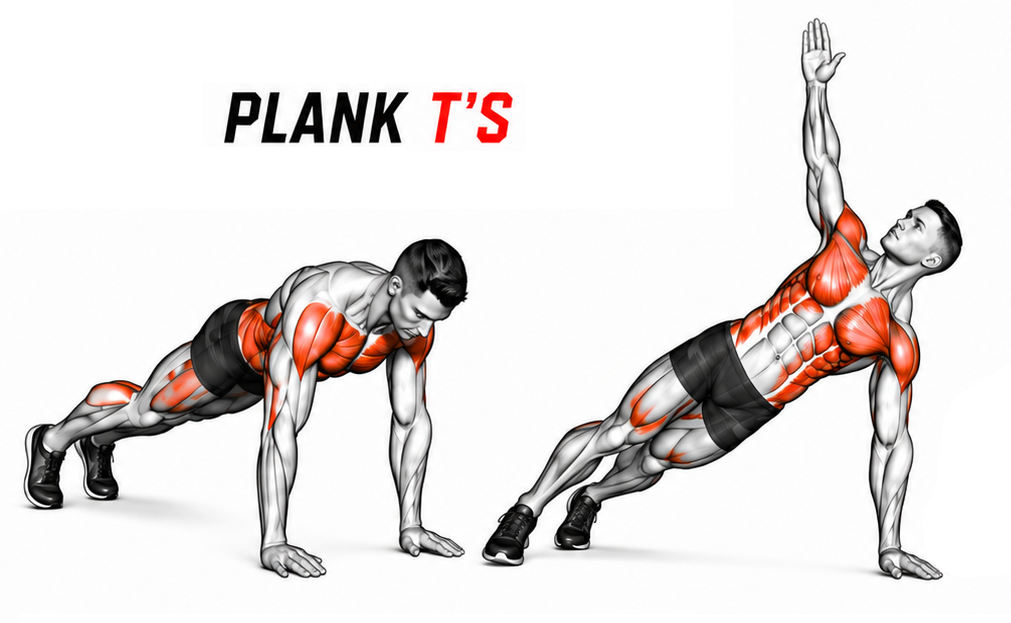
A rotating plank that opens from a high plank into a side plank, reaching the top arm to the ceiling to form a T and training rotary core control.
Level: Intermediate
Primary: Abs
Secondary: Shoulder Shoulders - Rear
Movement: Isolation
Tags: Anti-Rotation Core Stability
Type: Functional Fitness (Obstacle & Hybrid) ISO
Equipment: Body Weight
Target muscles
The obliques and the deep core control the rotation between the front plank and the side plank, while the rectus abdominis and transverse abdominis hold the body rigid throughout. The shoulders work hard — the supporting deltoid stabilises the whole bodyweight on one arm, and the rear delts and mid-back muscles raise and hold the top arm overhead. The glutes stay engaged to keep the hips from dropping in the side-plank position.
How to perform
Setup
Begin in a high plank with the hands under the shoulders, arms straight, feet about hip-width for a stable base, abs braced and hips level. A slightly wider foot stance makes the rotation easier to balance.
Execution
Shift your weight onto one hand and rotate the body open into a side plank, stacking or staggering the feet and reaching the free arm straight up toward the ceiling so the body forms a T. Keep the hips lifted and the body in one line as you open. Hold for a moment at the top, then rotate back down to the high plank under control and repeat to the other side. Lead the rotation with the hips and trunk rather than just throwing the arm up, and keep the supporting shoulder packed and stable. Move smoothly and deliberately, alternating sides with a steady, controlled rhythm.
Common mistakes
- Letting the hips sag toward the floor in the side-plank position instead of holding them lifted in a straight line.
- Throwing the top arm up with momentum rather than rotating the trunk under control.
- Collapsing into the supporting shoulder instead of keeping it packed and stable.
- Rushing the transitions so balance is lost and the body twists out of its straight line.
Progressions and regressions
Regress by rotating only partway, dropping the bottom knee to the floor in the side plank, or holding a static side plank on each side first. Progress by pausing longer at the top of the T, slowing the rotation, or holding a light dumbbell in the reaching hand for added load and rear-delt work. Performing it from the forearms changes the shoulder demand.
Programming notes
Program it as rotary-core and shoulder-stability work, three sets of six to ten rotations per side or thirty to forty seconds of alternating reps. It fits a core circuit or a functional warm-up well, covering rotation and single-arm support that straight planks miss. Keep the hips up and the movement controlled; balance both sides evenly to avoid building an asymmetry.