Bicycles
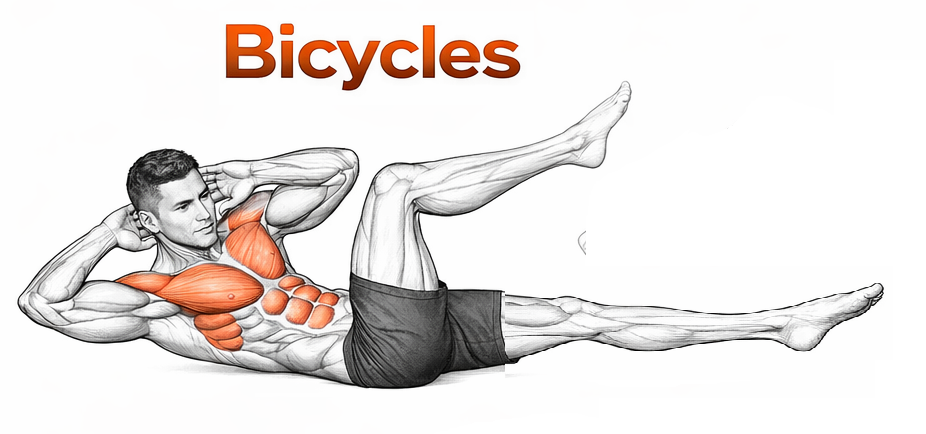
Lying alternating bicycle crunch — the classic ab burner that combines spinal flexion with rotation for a thorough oblique stimulus.
Level: Beginner
Primary: Abs
Movement: Isolation
Type: Functional Fitness (Obstacle & Hybrid)
Equipment: Body Weight
Sports: Cycling
Target muscles
The rectus abdominis drives the spinal flexion of each crunch. The obliques drive the rotational element — opposite elbow to opposite knee — which is what differentiates bicycles from a basic crunch. The hip flexors lift each knee toward the chest. The deep core stabilizes the lumbar spine through the rotation. Done well, bicycles train the abdominal wall through its full functional pattern (flex and rotate at the same time), which is closer to how the trunk works in sport than pure crunches.
How to perform
Setup
Lie on your back, hands lightly touching the sides of your head (not behind the neck — pulling on the neck is the most common cause of soreness from this exercise). Knees bent at 90 degrees, feet off the floor. Brace the trunk; the lower back should stay in light contact with the floor.
Execution
Lift the head and shoulders off the floor — that's the starting position. Bring one knee toward the chest while rotating the opposite elbow toward the rising knee. As the rotation completes, simultaneously extend the other leg straight out (not touching the floor) and rotate the trunk to the new side. Switch continuously, slowly, with control — left knee meets right elbow, right knee meets left elbow. Don't pull on the neck; don't yank through the rotations. Breathe in cycles, exhale on each rotation.
Common mistakes
- Pulling on the neck. Hands are placeholders; the rotation comes from the trunk, not the arms.
- Rushing the reps. Slow controlled cycling beats fast sloppy reps for hypertrophy and pattern training.
- Letting the extending leg drop to the floor between reps. Keep it elevated — that's part of the trunk demand.
- Lifting just the head rather than the head and shoulders. The shoulders come off the floor too; otherwise it's a neck exercise.
- Hyperextending the lower back as the leg extends. The lumbar should stay in contact with the floor; if it lifts, the hip flexors are taking over.
Progressions and regressions
Regress to alternating dead bugs (lying on the back, arms and legs extended, controlled lowering of one arm and the opposite leg) until the trunk control is dialed. Then add the crunching rotation. To progress, slow the tempo (3-second lowering on each leg extension), add a light dumbbell to the hands, or chain with hollow holds and V-ups for an unbroken trunk circuit.
Programming notes
Excellent ab finisher: 3-4 sets of 10-20 reps per side, two or three times a week. The trunk recovers quickly, so frequency can be high. Pair with anti-extension work (planks, rollouts) and anti-lateral-flexion work (side planks, suitcase carries) for a complete trunk program. Don't program right before a heavy squat or deadlift — fried ab tissue costs you bracing.