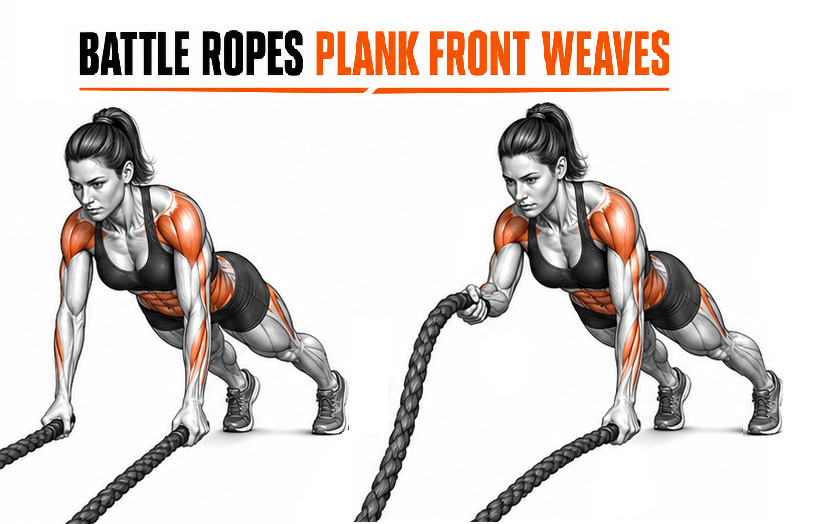
Battle Ropes Plank Front Weaves
A plank that drags a single rope side to side in front while the deep core fights rotation and the shoulders stabilise the moving load.
Level: Advanced
Primary: Abs
Secondary: Back - Upper Cardio Shoulder
Movement: Compound
Tags: Anti-Rotation Core Stability
Type: Anaerobic Intervals (HIIT / Bootcamp / Circuit) ISO
Equipment: Battle Ropes
Target muscles
The anterior core leads: the rectus abdominis and transverse abdominis hold the plank while the obliques fire hard to resist the rotation each rope drag tries to impose, making this a true anti-rotation exercise. The shoulders, serratus and upper back stabilise the moving arm and keep the plank line intact, and the working forearm grips to weave the rope. Holding a rigid plank while one arm hauls a heavy rope across also drives the heart rate up, so conditioning rides along with the core stability work.
How to perform
Setup
Set up in a high plank or push-up position facing the anchor, with a single rope laid across the floor in front of your hands. Set the hands directly under the shoulders, brace the abs hard, squeeze the glutes, and tuck the pelvis slightly so the lower back stays neutral. Square the hips so the body forms one straight line from heels to head, and take the slack out so the rope offers real resistance when you drag it.
Execution
Holding the plank rock-solid, reach one hand forward to grab the rope and drag or weave it across to the opposite side, then plant that hand and repeat with the other hand, moving the rope back and forth in front of you. The hips must stay level and square the entire time — the core's job is to refuse to rotate as each arm pulls. Move deliberately so the plank never breaks, keeping the spine neutral and the shoulders stacked. The slower and more controlled the weave, the harder the anti-rotation demand.
Common mistakes
- Letting the hips twist or rock as each hand reaches and drags the rope, which defeats the anti-rotation purpose.
- Piking the hips up or letting them sag instead of holding a flat plank line.
- Reaching with a long, fast yank that pulls you off balance rather than a controlled weave.
- Holding the breath, which makes the brace impossible to sustain through the interval.
Progressions and regressions
Regress to a standard plank, or to a plank with a slow single rope drag, until you can keep the hips dead level under load. Progress by using a heavier rope, slowing the weave, or widening the distance the rope travels across the floor. Lifting onto a single-arm plank between drags raises the stability demand sharply, and dropping to the forearms on the support side shortens the base and ramps the challenge to the shoulders.
Programming notes
Use it as advanced core and anti-rotation work, 3-4 sets of 20-40 seconds or 8-12 controlled weaves per side. It fits a core circuit or a conditioning block where you want trunk stability tested under fatigue. Keep the hips quiet and stop the set the moment the plank line breaks or the hips start to rotate rather than grinding through a wobbling, sagging hold.