Plate V-Ups
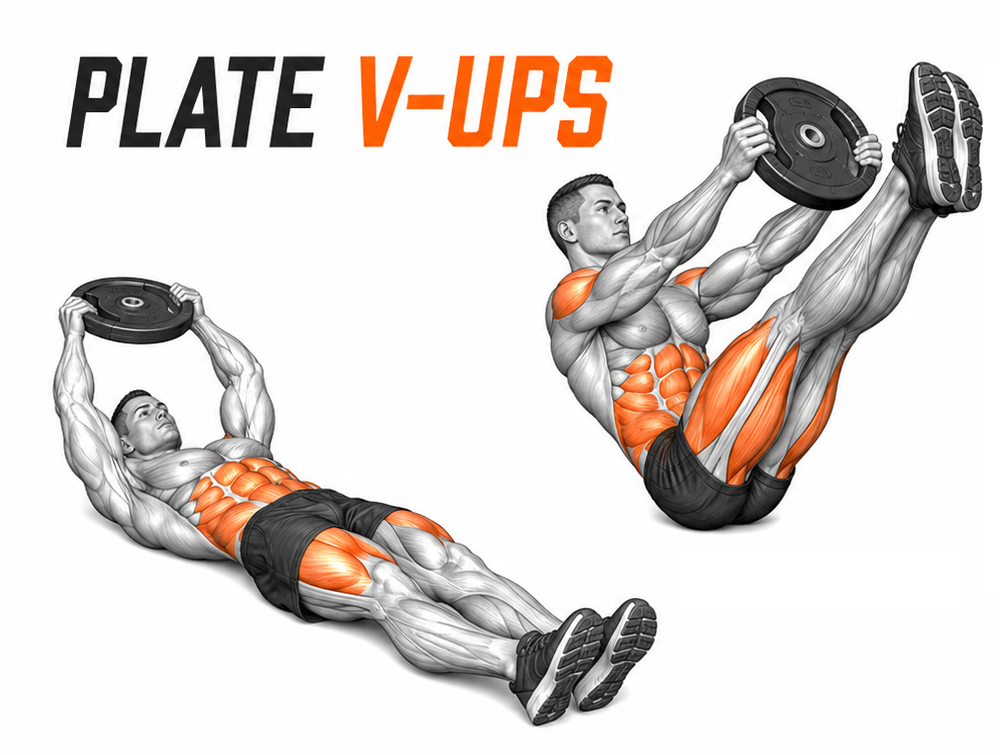
A V-up holding a plate overhead, lifting the torso and legs to meet while the added load drives a strong contraction through the whole ab wall.
Level: Intermediate
Primary: Abs
Secondary: Quads
Movement: Isolation
Tags: Core Stability
Type: Strength (Weight Lifting)
Equipment: Plates
Target muscles
The V-up loads the entire rectus abdominis as the torso and legs lift to meet in a V, with the hip flexors raising the legs and the obliques and transverse abdominis stabilising the spine. Holding a plate overhead lengthens the lever and adds resistance, so the abs work harder to fold the body up. It is a demanding dynamic core exercise that trains both the upper and lower portions of the abdominal wall in one movement.
How to perform
Setup
Lie flat on your back with the legs straight and arms extended overhead holding a plate. Press the lower back lightly into the floor and brace the core before the first rep.
Execution
Exhale and lift the torso and the straight legs at the same time, reaching the plate toward your feet so the body folds into a V, balancing on the hips. Squeeze the abs hard at the top, then lower the torso, legs and plate back toward the floor under control without letting them crash down. Keep the legs straight if you can, and move smoothly rather than throwing the plate up with momentum. Breathe out on the way up, in on the way down.
Common mistakes
- Using momentum to swing the plate up instead of contracting the abs.
- Bending the knees excessively, which reduces the lower-ab work.
- Letting the legs and torso crash down rather than lowering with control.
- Arching the lower back off the floor at the start of each rep.
Progressions and regressions
Regress by bending the knees (a tuck-up), using a lighter plate, or doing V-ups with no weight. Progress by using a heavier plate, slowing the lowering phase, adding a pause at the top, or keeping the legs perfectly straight throughout.
Programming notes
Program it as core work, 2-3 sets of 10-15 reps, after the main lifts. The added load makes it a strength-focused ab exercise rather than an endurance one, so keep the reps controlled and stop when form breaks. Pair it with an anti-rotation or anti-extension hold for well-rounded trunk training.