BOSU Military Plank
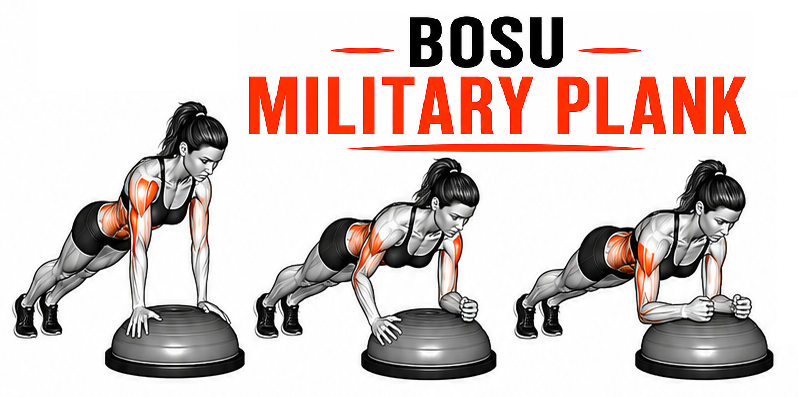
An up-down commando plank on the BOSU, lowering from hands to forearms and back, fighting hip rotation while the shoulders and triceps press.
Level: Intermediate
Primary: Abs
Secondary: Chest Shoulder Triceps
Movement: Isolation
Tags: Anti-Rotation Balance / Stability Core Stability
Type: Functional Fitness (Obstacle & Hybrid)
Equipment: Balance Trainer
Target muscles
Sometimes called a commando, this up-down plank turns a static hold into a dynamic anti-rotation drill. As you lower one arm at a time from the push-up position down to the forearms and back up, the obliques and transverse abdominis fight hard to keep the hips from rocking side to side, while the rectus abdominis stops the lower back sagging. The shoulders, triceps and chest do the pressing work of lowering and raising the body, and the glutes hold the straight line. Doing it on the dome adds a constant balance correction the floor version never demands.
How to perform
Setup
Start in a high plank with both hands on the BOSU rim or platform, dome down, body in a straight line from heels to head and core braced. Set the feet about hip-width for a stable base.
Execution
Lower one arm to its forearm on the dome, then the other, so you are in a forearm plank — then press back up one arm at a time to the high plank. That down-down-up-up sequence is one rep. The whole job is to keep the hips perfectly square as the support shifts from arm to arm: resist the urge to swing the pelvis toward whichever arm is moving. Keep the dome quiet, alternate the leading arm each rep, and move with control rather than rushing — the rotation control is the point.
Common mistakes
- Letting the hips rock or twist side to side as each arm transitions.
- Piking the hips up to make the press easier instead of holding the plank line.
- Leading with the same arm every rep so one side does all the work.
- Rushing the transitions so the dome rocks and the core stops bracing.
Progressions and regressions
Regress by performing the up-downs on the floor, dropping to the knees, or holding a static forearm plank until the transitions feel controlled. Progress by widening the feet less for a narrower base, adding a push-up between transitions, or lifting one foot off the floor as you switch arms.
Programming notes
Program it as dynamic core and shoulder-stability work, 2-3 sets of 8-12 reps (counting a full down-up cycle as one) or timed 30-40 second efforts. Stop when the hips start swinging rather than grinding out sloppy reps. It pairs well with a static anti-rotation hold to train the trunk to both resist and control rotation.