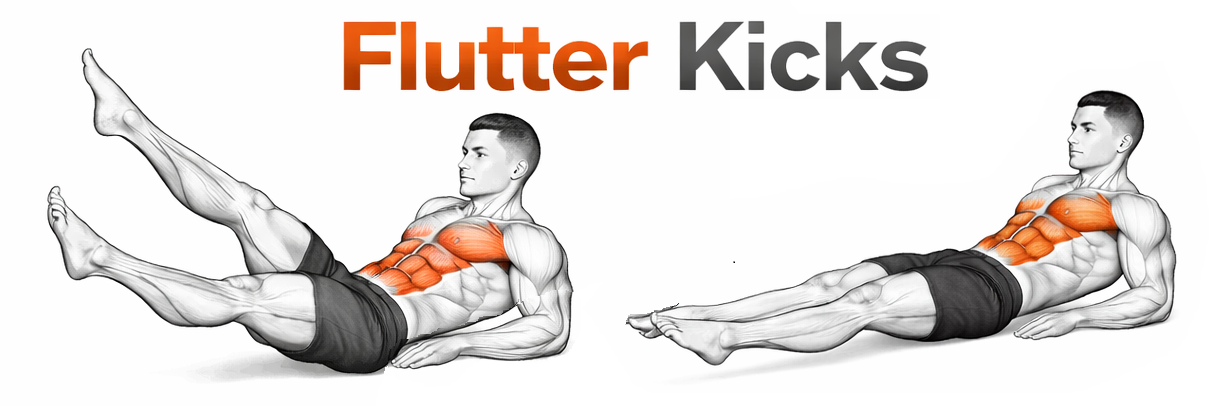
Flutter Kicks
Lying alternating leg flutter — direct lower-ab work with low-impact endurance demand.
Level: Beginner
Primary: Abs
Movement: Isolation
Type: Aerobic (Cardio)
Equipment: Body Weight
Sports: Football MMA Rugby Soccer
Target muscles
The lower rectus abdominis and the hip flexors fire continuously to hold and move the legs. The deep core stabilizes the lumbar spine — protecting the lower back from extension is the most important cue. The deep hip flexors (iliopsoas) work hard. As an ab exercise, the flutter kick targets the often-undertrained lower abs.
How to perform
Setup
Lie on your back with legs extended and hands tucked under your hips for lower-back support (or the hands at the sides of the head, depending on the version). Lift both legs a few inches off the floor. The lower back stays pressed into the floor throughout.
Execution
Alternate raising and lowering each leg in a quick scissor-like motion — one leg rises while the other lowers, never letting either touch the floor. The motion is small and rapid. The lower back stays pinned to the floor; if it lifts, the load is too much for the trunk and the set should end. Continuous tempo.
Common mistakes
- Lower back lifting off the floor. The instant it does, the trunk is failing.
- Going too high or too low with the legs. Small range, rapid rhythm.
- Letting one leg touch the floor. Both legs stay elevated throughout.
- Holding the breath. Breathe in cycles.
- Doing them when the lower back is already taxed.
Progressions and regressions
Regress to bent-knee flutters (knees slightly bent rather than straight) until the lower back can stay pinned. To progress, slow the tempo (long-cycle flutters with 1-second pauses), add ankle weights, or work for time intervals.
Programming notes
Lower-ab accessory work. 3 sets of 30-60 seconds, two or three times a week. Pair with planks (anti-extension) and Russian twists (rotation) for a complete trunk program.