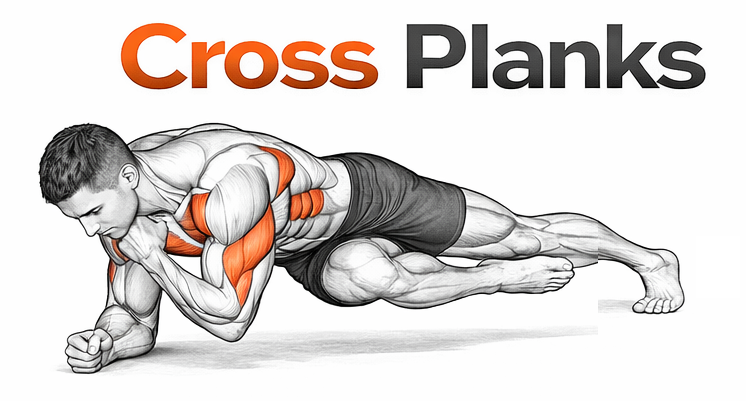
Cross Planks
Plank with alternating shoulder taps or knee touches — adds an anti-rotation challenge to the standard plank.
Level: Beginner
Primary: Abs
Movement: Isolation
Tags: Core Stability
Type: ISO
Equipment: Body Weight
Sports: Gymnastics MMA Swimming
Target muscles
The obliques fire hard to resist trunk rotation each time a hand or knee lifts — that asymmetric load is the entire point. The rectus abdominis and transverse abdominis brace continuously. The serratus anterior and anterior deltoids hold the shoulders stable. The glute medius of the planted-hand and planted-foot side works to keep the hips level. The trunk does most of the visible work; the shoulders and hips do the underrated stabilization that lets the trunk work cleanly.
How to perform
Setup
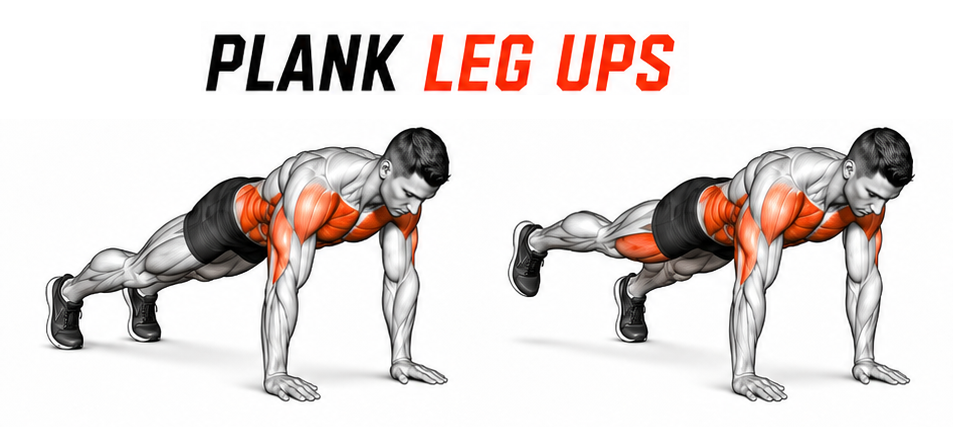
Set up in a high plank position — hands under shoulders, body in a straight line from head to heels, feet hip-width apart (or wider for more stability if needed). Pack the shoulders, brace the trunk hard. Take a breath in.
Execution
Lift one hand and tap the opposite shoulder, then return to the plank. Switch hands and tap the other shoulder. The hips and shoulders stay absolutely square throughout — no rocking, no twisting. The challenge is keeping the body still while moving one limb at a time. Slow controlled taps; this isn't a speed exercise. Some versions tap knees instead of shoulders (more lower-body trunk control); pick the variant and stay consistent. Continue alternating for the prescribed reps or time.
Common mistakes
- Letting the hips rotate when a hand lifts. The hips stay square — if they rotate, the load is too unstable; widen the feet for more base support.
- Lifting and replacing the hand quickly to skip the unstable moment. The brief one-hand support is the entire training stimulus.
- Sagging hips or piking up. Hold a clean plank position throughout.
- Rushing the alternating taps. Slow control trains the trunk; fast taps train nothing.
- Holding the breath. Breathe in cycles, exhale on each tap.
Progressions and regressions
Regress to the standard plank (no taps) for 60 seconds before adding the unilateral demand. Knee taps (touching opposite knee to opposite hand from a plank) are an alternative pattern. To progress, work for time (60 seconds of continuous alternating taps), narrow the foot stance for more anti-rotation demand, or chain with up-down planks (forearm to high plank and back).
Programming notes
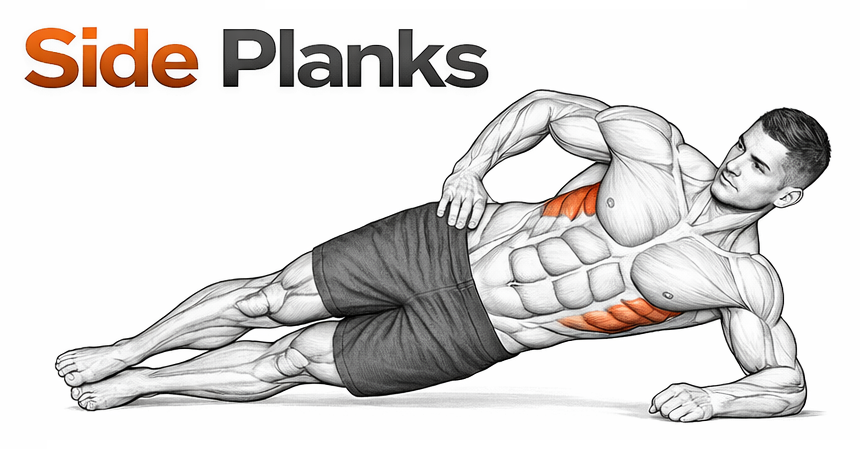
Excellent trunk-stability work. 3 sets of 10-20 taps per side, or 30-45 seconds of continuous alternation, two or three times a week. Use as a finisher after compound lifts, or as part of a circuit during warm-up. Pair with anti-extension work (rollouts) and anti-lateral-flexion (side planks) for a complete trunk program.