Sandbag Spins
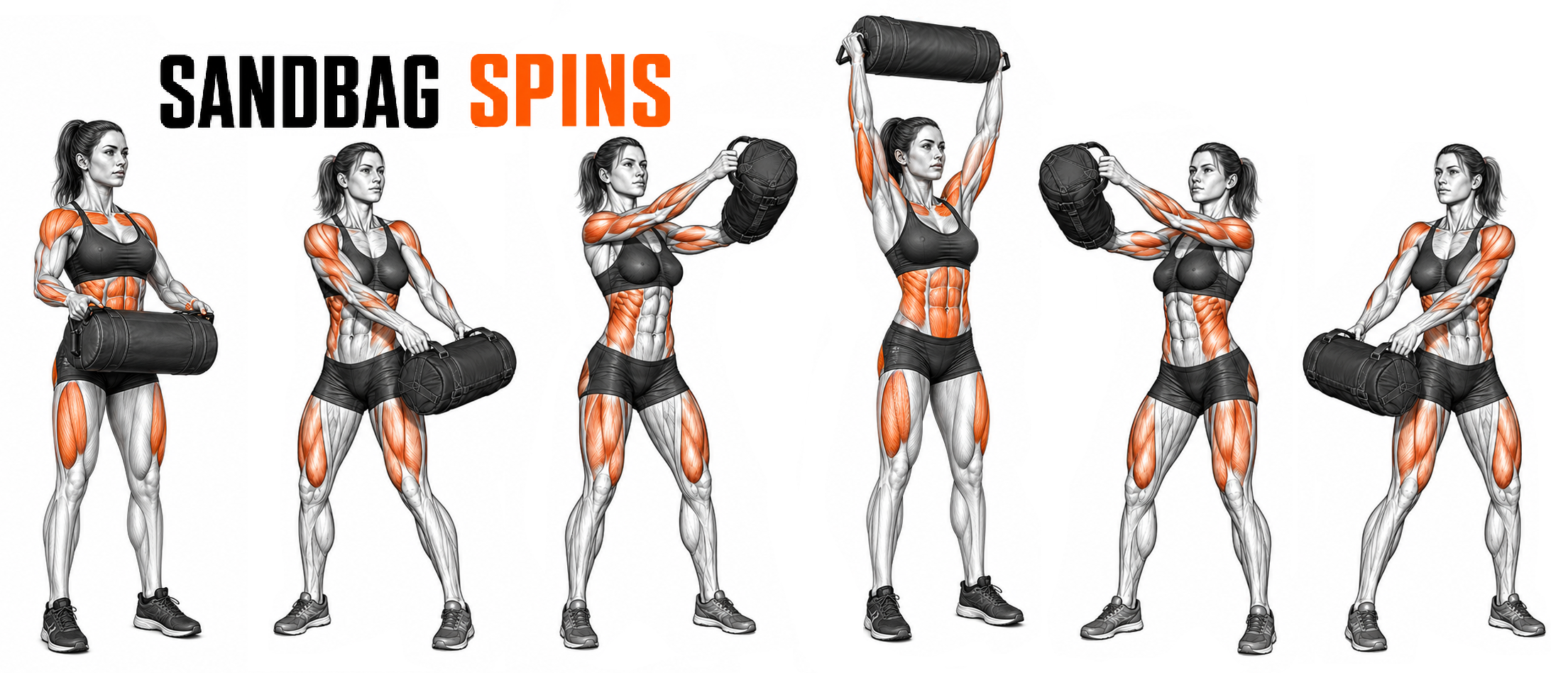
A continuous sandbag circle around the body and waist, the core controlling a rotating load through a full 360-degree path.
Level: Intermediate
Primary: Abs
Secondary: Forearms Shoulder
Movement: Compound
Tags: Rotational
Type: Flexibility (Dynamic Stretching) Functional Fitness (Obstacle & Hybrid)
Equipment: Sandbag
Target muscles
The obliques and rectus abdominis work continuously to control the bag as it travels around the body, smoothly accelerating and decelerating the load through each portion of the circle. The shoulders and forearms pass and grip the bag from hand to hand, and the glutes and deep core keep the hips stable and the trunk upright so the rotation comes from controlled movement rather than a flailing spine. It trains rotary control, coordination and grip endurance together.
How to perform
Setup
Stand with feet shoulder-width and a tall, braced posture, holding the sandbag in both hands in front of your waist. Soften the knees and set the core so the spine stays stacked as the load moves around you.
Execution
Begin passing the bag around your waist in a continuous circle, handing it from one hand to the other as it travels behind your back and returns to the front. Keep the circle smooth and the bag close to the body, letting the core control the momentum rather than letting the bag swing you around. Maintain an upright torso and steady hips throughout, resisting the urge to lean or twist excessively. Complete a set number of circles in one direction, then reverse to circle the other way so both rotational directions are trained equally.
Common mistakes
- Letting the bag swing wide and pull the torso around rather than keeping it close and core-controlled.
- Leaning the trunk to follow the bag instead of staying tall and braced.
- Only circling in one direction, which trains the rotation unevenly.
- Using a bag so heavy the pass becomes a clumsy heave rather than a smooth circle.
Progressions and regressions
Regress to a lighter bag or smaller, slower circles, or practise the pass around the head or waist separately, until the coordination is comfortable. Progress by adding filler, speeding up the circles for a conditioning effect, or combining waist circles with overhead halos. Pairing spins with a squat or lunge between sets builds it into a flowing movement complex.
Programming notes
Use it as a dynamic core, mobility and coordination drill, 2-3 sets of 5-10 circles in each direction. It works well as part of a warm-up to wake up the trunk and shoulders, or as low-intensity rotational conditioning in a circuit. Keep the load light to moderate and the movement smooth — this is a control and coordination exercise, not a maximal-strength one.