Disc Slider Mountain Climbers
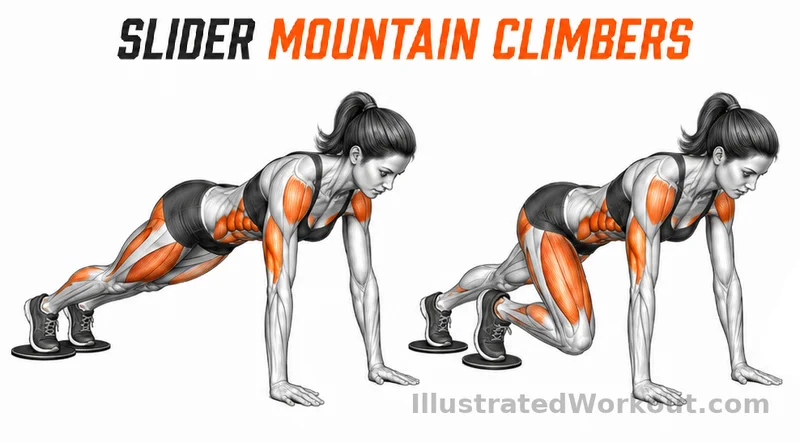
Feet on the sliders let the knees drive in and out smoothly and fast, keeping the abs braced while the heart rate climbs.
Want a disc sliders core workout?
Our wizard builds one around your time, goal, and equipment in about two minutes. Free — no signup needed.
Make Me a Workout → Just did it? Track your setsFeet on the sliders let the knees drive in and out smoothly and fast, keeping the abs braced while the heart rate climbs.
Level: Intermediate
Primary: Abs
Secondary: Cardio Shoulder
Movement: Isolation
Tags: Core Stability
Type: Anaerobic Intervals (HIIT / Bootcamp / Circuit) Functional Fitness (Obstacle & Hybrid)
Equipment: Disc Sliders
Target muscles
The abs and hip flexors do the running, alternately driving each knee toward the chest and controlling it back to a plank, while the obliques resist the twist that wants to creep in with each stride. The anterior deltoids, chest and triceps hold the plank base steady, and the constant leg cycling drives the heart rate up quickly. The sliders remove the ground contacts of a normal mountain climber, so the pattern stays smooth and continuous and the core never gets a rest.
How to perform
Setup
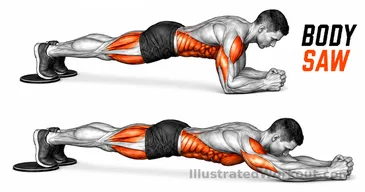
Take a high plank with both feet on sliders and the hands stacked under the shoulders. Push the floor away to set the shoulder blades, brace the abs and squeeze the glutes so the body holds a straight line. Fix the gaze just ahead of the hands and shift the ribs down toward the hips to pre-brace.
Execution
Glide one knee in toward the chest, then switch, driving the other knee in as the first slides back out, building a smooth running rhythm on the discs. Keep the hips low and level so the pelvis does not bob up and down, and hold the shoulders stacked over the wrists. Move as fast as you can while keeping each knee drive controlled and the plank rigid. Breathe steadily with the cadence and keep the core braced so the lower back never sags as the pace climbs.
Common mistakes
- Letting the hips pike up high so it becomes a bouncing pike rather than a level plank run.
- Rocking the shoulders forward and back instead of keeping them stacked over the wrists.
- Letting the trailing knee only glide partway rather than returning to a full plank each stride.
- Losing the brace as speed rises, so the lower back sags and takes over the work.
Progressions and regressions
Regress by slowing the cadence to a deliberate one-knee-at-a-time tuck, or by placing sliders under the hands with the feet planted. A standing or incline mountain climber is an easier entry. Progress by increasing speed, adding cross-body knee drives to hit the obliques harder, or working in timed sprints against a clock for a stiffer conditioning stimulus.
Programming notes
Program it as core-driven conditioning or a circuit station, thirty to forty-five seconds of continuous reps or fast timed bursts. It builds core endurance and shoulder stability while raising the heart rate, so it suits HIIT and bootcamp formats. Keep the hips level as fatigue sets in, and drop the pace before the plank collapses, since a sagging climber puts needless strain on the lower back.