Disc Slider Body Saws
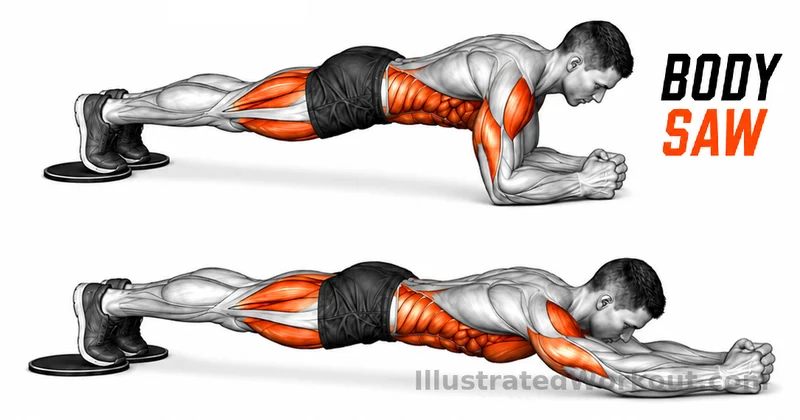
From a forearm plank, the whole body rocks forward and back on foot sliders, keeping the abs under constant tension the entire time.
Want a disc sliders core workout?
Our wizard builds one around your time, goal, and equipment in about two minutes. Free — no signup needed.
Make Me a Workout → Just did it? Track your setsFrom a forearm plank, the whole body rocks forward and back on foot sliders, keeping the abs under constant tension the entire time.
Level: Foundation
Primary: Abs
Secondary: Glutes Shoulder
Movement: Isolation
Tags: Core Stability
Type: Functional Fitness (Obstacle & Hybrid) ISO
Equipment: Disc Sliders
Target muscles
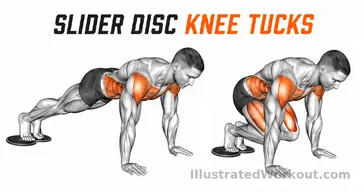
The rectus abdominis and transverse abdominis carry the whole exercise, holding the plank rigid while the body slides forward and back and the lever length keeps changing. The obliques stabilise against any twist, the anterior deltoids bear the load as the shoulders travel behind and ahead of the elbows, and the glutes stay squeezed to protect the lower back. The lats and serratus keep the shoulder blades set throughout.
How to perform
Setup
Set up in a forearm plank with both feet on sliders, elbows under the shoulders and forearms flat. Brace the abs hard, tuck the tailbone slightly and squeeze the glutes so the spine stays neutral. Push the forearms into the floor to spread the shoulder blades before you start the saw.
Execution
Rock the body backward by pushing gently through the forearms so the feet glide back and the shoulders travel behind the elbows, then reverse and slide forward until the shoulders pass ahead of the elbows. Move slowly, a few inches each way, keeping the plank line perfectly rigid the whole time. Never let the hips dip or the low back arch as the lever lengthens. Breathe in short, controlled breaths and let the abs, not momentum, drive the sawing motion.
Common mistakes
- Letting the hips sag as the body slides forward and the abdominal lever gets longer.
- Sawing too far too fast so the shoulders and low back take over from the core.
- Piking the hips upward to make the movement easier instead of holding a flat line.
- Holding the breath and losing the brace, which lets the spine round or overextend.
Progressions and regressions
Regress to a static forearm plank, or shorten the saw to just a couple of inches while the core adapts. Placing sliders under the forearms instead of the feet also reduces the lever. Progress by sawing a longer range, adding a slow tempo pause at the fully-forward position, or wearing a weight vest to load the plank as you rock.
Programming notes
Treat it as an anti-extension core builder, three to four sets of eight to twelve slow saws or twenty to thirty seconds of continuous movement. It fits neatly into core circuits and warm-ups for heavy lifting because it grooves a braced trunk. Keep the range honest and stop when the hips start to drop; a shorter, cleaner set beats a long one that leaks tension into the lower back.