Disc Slider Knee Tucks
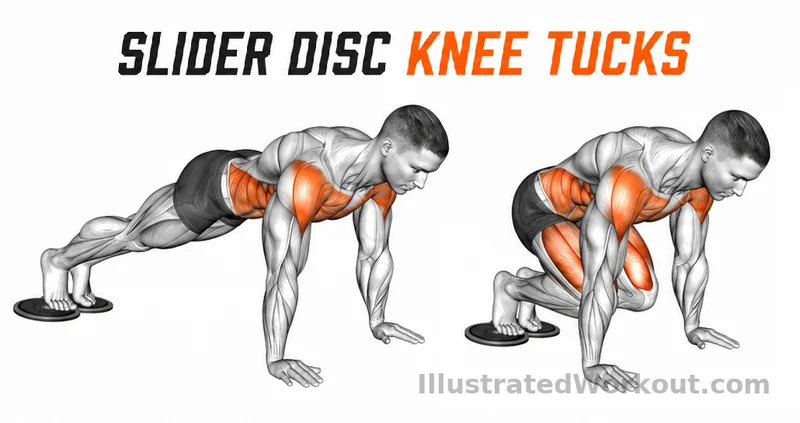
From a plank with feet on the sliders, both knees draw in toward the chest and glide back out, contracting the abs through a full range.
Want a disc sliders core workout?
Our wizard builds one around your time, goal, and equipment in about two minutes. Free — no signup needed.
Make Me a Workout → Just did it? Track your setsFrom a plank with feet on the sliders, both knees draw in toward the chest and glide back out, contracting the abs through a full range.
Level: Intermediate
Primary: Abs
Secondary: Quads Shoulder
Movement: Isolation
Tags: Core Stability
Type: Functional Fitness (Obstacle & Hybrid) ISO
Equipment: Disc Sliders
Target muscles
The rectus abdominis and the hip flexors do the pulling, drawing the knees in toward the chest and controlling them back out to a long plank. The obliques stabilise so the hips do not rock, while the anterior deltoids, chest and triceps support the whole upper body on a fixed base. The glutes and quads stay engaged to keep the legs organised as they glide, making it a moving-plank pattern that keeps the core under tension throughout.
How to perform
Setup
Set up in a high plank with both feet on sliders and the hands stacked under the shoulders. Push the floor away to spread the shoulder blades, brace the abs and squeeze the glutes so the body holds one straight line. Shift the ribs down toward the hips to pre-load the core before the first tuck.
Execution
Draw both knees in toward the chest by contracting the abs, letting the sliders glide the feet forward until the knees are tucked under the hips. Pause briefly, then glide the feet back out to a full plank under control, resisting the slide so the abs stay loaded. Keep the shoulders stacked over the wrists and the hips from piking up as the knees come in. Move smoothly and breathe with the rhythm — exhale as you tuck, inhale as you extend — and keep the plank line rigid at full stretch.
Common mistakes
- Piking the hips high toward the ceiling instead of tucking the knees under with the abs.
- Letting the hips sag on the way back out rather than holding a firm plank line.
- Yanking the knees in with momentum instead of a controlled abdominal contraction.
- Letting the shoulders drift ahead of or behind the wrists as the feet slide.
Progressions and regressions
Regress by tucking one knee at a time, or by placing the sliders under the hands and stepping the feet instead. A static slider plank builds the base strength first. Progress by slowing the tempo, pausing with the knees fully tucked, adding a pike at the end of the tuck, or driving the tucks faster to turn it into a conditioning piece.
Programming notes
Program it as dynamic core work, three sets of ten to fifteen controlled reps, or thirty seconds of continuous tucks in a circuit. It fits core blocks and full-body sessions and doubles as light shoulder-stability work. Keep the hips level and the plank rigid as fatigue climbs, and switch to single-knee tucks if the lower back starts to take over from the abs.