Disc Slider Glide Outs
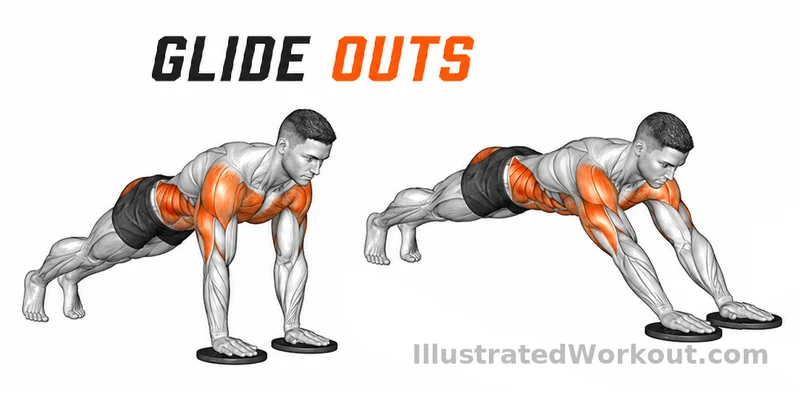
Kneeling with the hands on sliders, the arms glide forward into a long body line and pull back, working the abs like a slow rollout.
Want a disc sliders core workout?
Our wizard builds one around your time, goal, and equipment in about two minutes. Free — no signup needed.
Make Me a Workout → Just did it? Track your setsKneeling with the hands on sliders, the arms glide forward into a long body line and pull back, working the abs like a slow rollout.
Level: Intermediate
Primary: Abs
Secondary: Back - Upper Shoulder
Movement: Isolation
Tags: Core Stability
Type: Functional Fitness (Obstacle & Hybrid) ISO
Equipment: Disc Sliders
Target muscles
Reaching the arms out on the sliders turns this into an anti-extension battle for the front of the core. The deep abdominal wall resists extension as the arms travel forward and the body stretches into a long line, then contracts to pull everything back. The lats and teres major do the actual pulling to return the arms, the anterior deltoids stabilise the moving shoulders, and the glutes stay squeezed to keep the pelvis tucked and the low back safe. It is an anti-extension pattern, so the front of the core is under tension the whole way out and back.
How to perform
Setup
Kneel on a mat with a slider under each hand, hands under the shoulders and hips stacked over the knees. Tuck the pelvis, brace the abs and squeeze the glutes so the spine is neutral. Set the shoulders down away from the ears and pin the ribs down before the first rep.
Execution
Glide both hands slowly forward, letting the hips open as the body lengthens toward the floor, only going as far as you can while keeping the low back flat. Pause briefly at full reach, then pull the sliders back in by driving the lats and drawing the abs in hard until you return to the kneeling start. Move under control the entire time and never let the hips sag or the back arch. Exhale as you reach out and keep the glutes tight to protect the spine at the farthest point.
Common mistakes
- Reaching out past the point where the low back can stay flat, letting the spine arch and sag.
- Using the arms and shoulders to yank back instead of pulling with the lats and bracing the core.
- Letting the hips pike up on the return rather than keeping a long, controlled body line.
- Speeding through the range so momentum, not the abs, does the work.
Progressions and regressions
Regress by shortening the glide distance, or by reaching out and simply holding a shorter position while the core adapts. An incline version with the hands on a raised surface reduces the load. Progress by gliding to a full extended reach, adding a pause at the far position, or moving from the knees to the feet for a standing rollout that dramatically raises the anti-extension demand.
Programming notes
Program it as a core-strength staple, three to four sets of six to twelve controlled reps. It fits at the end of a training session or in a dedicated core block, and it teaches the braced, tucked position that protects the spine under load. Increase range before adding any speed, and stop the set the moment the low back cannot stay flat, since an arched glide-out puts the lumbar spine at risk.