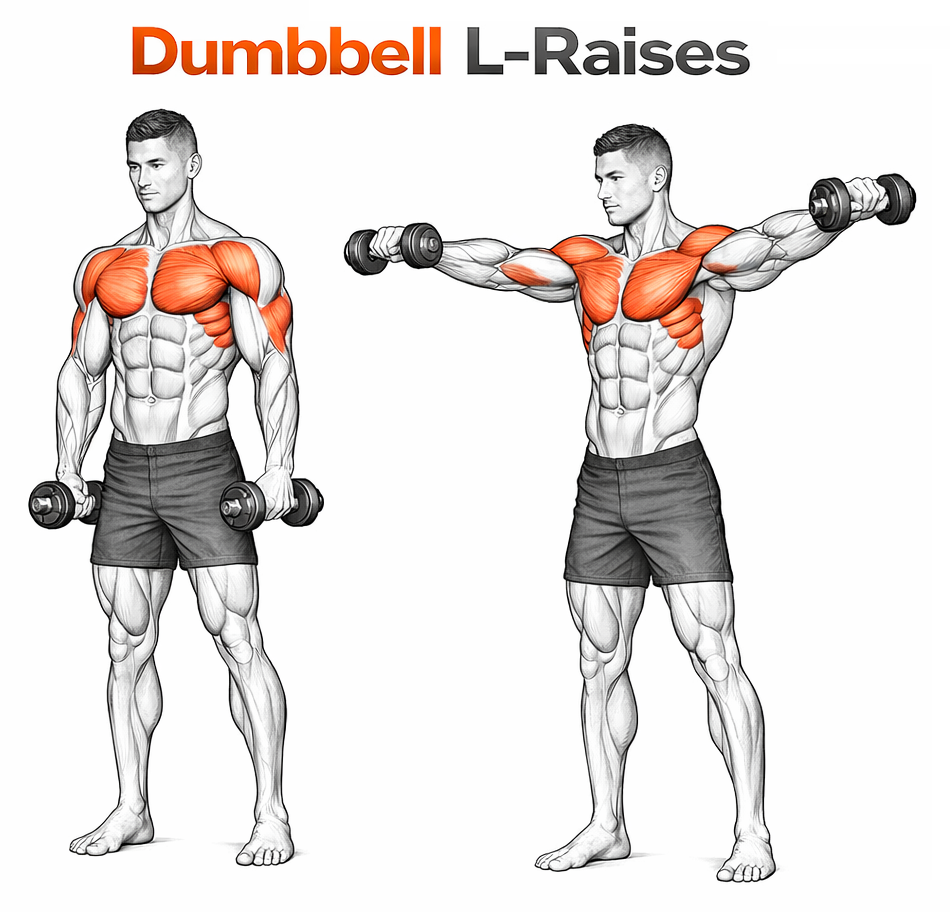
Dumbbell L-Raises
Simultaneous one-arm-front, one-arm-side raise forming an L — challenges shoulder coordination and front-and-lateral-delt control in one rep.
Level: Beginner
Primary: Shoulder
Movement: Isolation
Type: Strength (Weight Lifting)
Equipment: Dumbbell
Sports: Swimming Volleyball
Target muscles
The anterior deltoid of the front-raising arm and the lateral deltoid of the side-raising arm work simultaneously. The trunk braces against the asymmetric loading. The serratus anterior of both shoulders stabilizes the scapulae. The traps work to hold both shoulders down through the lift. As a coordination drill, the L-raise builds the kind of shoulder control that helps overall pressing performance.
How to perform
Setup
Stand holding a dumbbell in each hand at the sides. Slight bend in both elbows. Trunk braced. Take a breath.
Execution
Simultaneously raise one arm straight in front of you (front raise) and the other directly out to the side (lateral raise). Both arms end at shoulder height, forming an L shape with the body. Pause briefly. Lower both arms back to the sides under control. On the next rep, switch which arm goes forward and which goes to the side. Alternate continuously. The torso stays still throughout.
Common mistakes
- Going too heavy. The coordination demand caps the working weight; lighter loads are appropriate.
- Swinging the torso. The body stays still.
- Forgetting to alternate sides. Each rep alternates the front-side combination.
- Cutting one arm's range short. Both arms reach shoulder height.
- Bouncing at the bottom. Pause briefly between reps.
Progressions and regressions
Regress by doing front raises and lateral raises as separate exercises until each is dialed. To progress, work pause L-raises (2-second hold at peak), or alternate L-raises with regular lateral and front raises in the same session for a complete shoulder stimulus.
Programming notes
Accessory shoulder work. 3 sets of 10-12 reps per side. Once or twice a week. Useful as a finisher when you want both front and lateral deltoid stimulus efficiently. Pair with rear-delt work for balanced shoulder development.