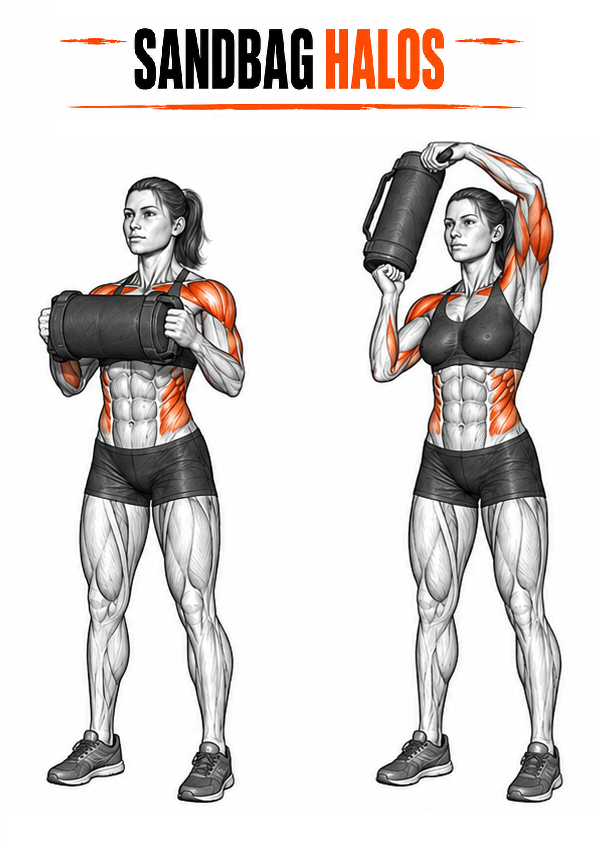
Sandbag Halos
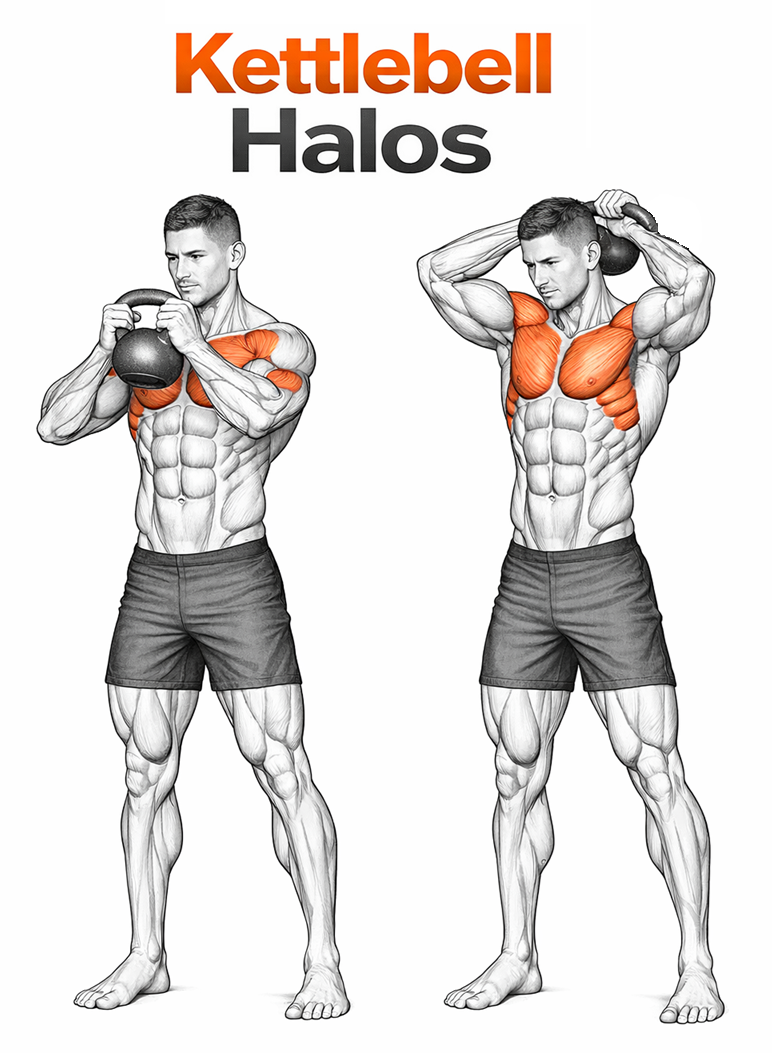
Shoulder-mobility halo circling the sandbag around the head close to the skull, opening the shoulders while the core resists the rotating load.
Level: Foundation
Primary: Shoulder
Secondary: Abs Traps
Movement: Isolation
Tags: Rotational
Type: Flexibility (Dynamic Stretching) Functional Fitness (Obstacle & Hybrid)
Equipment: Sandbag
Target muscles
The deltoids and the muscles of the rotator cuff work through a large range to circle the load around the head, building shoulder mobility and stability at the same time. The trapezius and upper back control the bag overhead, while the abs and obliques brace to stop the torso swaying as the offset load travels around the skull. Holding the awkward bag close also keeps the forearms and grip engaged throughout the circle.
How to perform
Setup
Hold the bag in front of your chest, gripping it by its handles or the ends of its body with both hands. Stand tall with feet shoulder-width, brace the abs, and pull the shoulders down away from the ears before you start to move.
Execution
Circle the bag up and around your head, keeping it as close to your skull as you safely can without bumping it, tracing a full halo from front to one side, around the back of the head, to the other side, and back to the front. Keep your torso still and upright — only the arms and shoulders should move, while the core resists the pull of the load swinging around. Complete the prescribed reps in one direction, then reverse and circle the other way for equal reps. Move smoothly and deliberately; this is a controlled mobility drill, not a speed exercise.
Common mistakes
- Letting the bag drift far from the head, which turns it into a wide swing and loses the mobility benefit.
- Swaying the hips and torso to help the bag around instead of bracing the core still.
- Shrugging the shoulders up toward the ears rather than keeping them packed down.
- Circling only one direction or unequal reps, building an asymmetry in the shoulders.
Progressions and regressions
Regress by using a lighter bag or a smaller, slower circle until the shoulders move freely and the core stays braced. Progress by adding weight, slowing the tempo, or performing halos from a half-kneeling or tall-kneeling stance to remove the legs and increase the core demand. A standing-to-kneeling flow adds a fuller mobility challenge.
Programming notes
Use it in a warm-up to prepare the shoulders for overhead work, or as core and mobility accessory, 2-3 sets of 5-8 circles per direction. The light, controlled nature makes it ideal before pressing or Olympic-style lifting. Keep the load modest and the path tight to the head so the shoulders are mobilised rather than yanked, and always balance the reps in both directions.