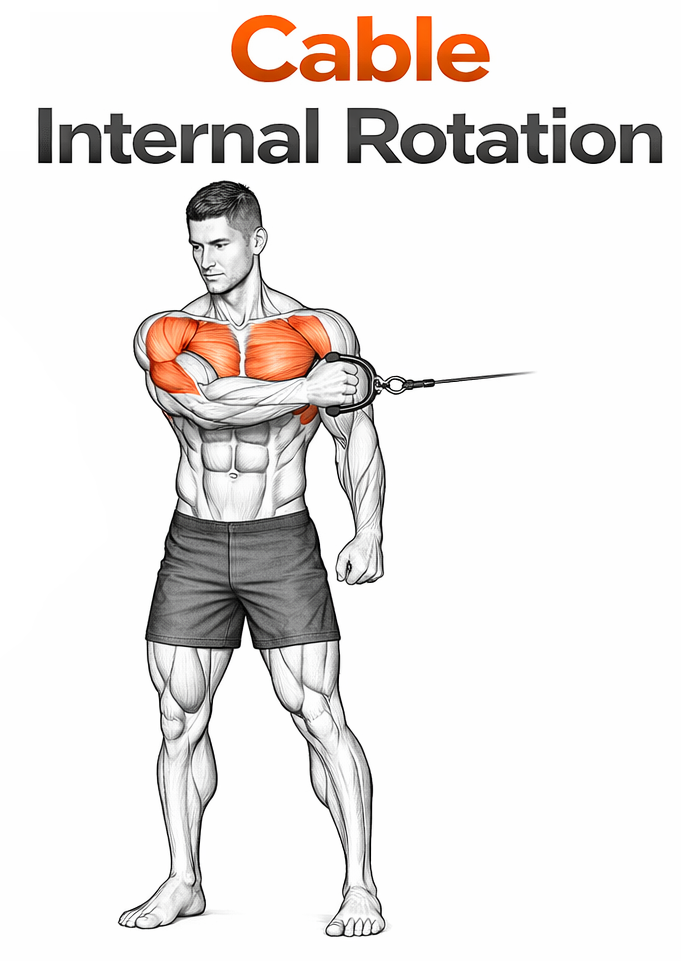
Cable Internal Rotation
Sideways cable internal rotation with the elbow pinned — strengthens the subscapularis and other internal rotators, completing the rotator-cuff picture.
Level: Beginner
Primary: Shoulder
Movement: Isolation
Type: Strength (Weight Lifting)
Equipment: Cable
Sports: Baseball Cricket Golf Tennis
Target muscles
The subscapularis (the rotator cuff muscle on the front of the scapula) is the prime mover. The pectoralis major (sternal portion) contributes. The teres major and the anterior deltoid assist. The serratus anterior and lower trapezius stabilize the scapula. This is the internal-rotation counterpart to the external-rotation cable lift; doing one without the other unbalances the cuff and tends to produce shoulder problems over time. Both rotator-cuff directions need training, ideally in equal volume.
How to perform
Setup
Set a cable to elbow height. Stand sideways to the cable with the working arm closest to the machine. Grip the handle with the working hand. Pin the elbow tight to the side at 90 degrees of flexion. The forearm points outward toward the cable. Use a rolled towel under the elbow to keep it from drifting.
Execution
Rotate the forearm inward across the body — the working hand moves toward and past the front of the abdomen. The elbow stays pinned to the side throughout. The torso stays still. Pause for a one-second contraction at end range. Return the forearm under control to the start. Same as external rotation, the range is small (about 60-90 degrees of useful work), the loads are very light, and the cadence is deliberate.
Common mistakes
- Loading too heavy. The subscapularis is small. Five pounds is a meaningful load; twenty is enormous.
- Letting the elbow drift forward off the side. Use the towel under the elbow for clean position.
- Twisting the torso to assist. The body stays square; only the forearm moves.
- Rushing the reps. Slow controlled — two seconds in, one-second hold, two seconds out.
- Skipping this lift while doing external rotations. Both directions need work for a balanced cuff.
Progressions and regressions
Regress to band internal rotations (light resistance bands) until the form is automatic. To progress, work the 90/90 internal rotation (arm abducted to 90 degrees, elbow bent to 90, rotate the forearm down against the cable), or add a brief end-range hold to each rep.
Programming notes
Shoulder-health insurance, not muscle-building. 2-3 sets of 12-15 reps per side, two or three times a week. Always paired with cable external rotation work in roughly equal volume — training one direction without the other unbalances the rotator cuff. Use as warm-up before pressing days or accessory work at the end of upper-body sessions.