Battle Ropes Side Winders
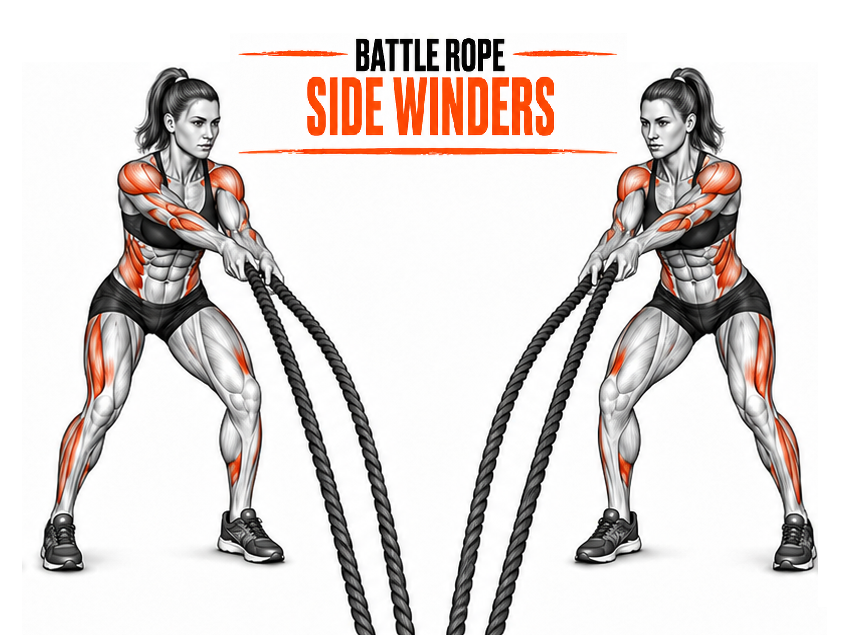
The shoulders sweep both rope ends together side to side, snaking the ropes laterally while the obliques drive the rhythmic rotation.
Level: Foundation
Primary: Shoulder
Secondary: Abs Cardio Forearms
Movement: Compound
Tags: Rotational
Type: Aerobic (Cardio) Anaerobic Intervals (HIIT / Bootcamp / Circuit)
Equipment: Battle Ropes
Target muscles
The deltoids drive both arms side to side together to snake the ropes laterally across the body, working through a wide horizontal range. The obliques and rotational core supply the rhythmic turn that carries the ropes from one side to the other and decelerate them on each pass. The forearms grip continuously and the upper back stabilises the shoulders. The constant side-to-side sweeping keeps the shoulders and core under tension and elevates the heart rate, blending coordination with conditioning.
How to perform
Setup
Hold a rope end in each hand, or both together, facing the anchor with light tension on the line. Set a shoulder-width stance with soft knees and a braced trunk, the chest tall and the shoulders set down and back. Hold the ropes in front at waist height with a slight bend in the elbows, your weight balanced through the midfoot, and find the tension before you begin sweeping the ends laterally from side to side.
Execution
Sweep both ends to one side together, letting the trunk rotate slightly with the motion, then reverse and sweep them to the other side, sending lateral, snaking waves down the ropes. Keep the sweeps wide and even, driving from the shoulders while the obliques control the rotation. Maintain a steady side-to-side rhythm so the ropes snake continuously to the anchor. Hold the stance and keep the lower back quiet, letting the hips and shoulders rotate rather than wrenching the spine to force the sweep.
Common mistakes
- Twisting the lower back to fling the ropes instead of rotating from the hips and driving from the shoulders.
- Letting the sweep shrink so the ropes barely snake from side to side.
- Moving the arms while keeping the trunk locked, which kills the rotational component.
- Losing posture and hunching forward as the interval wears on.
Progressions and regressions
Regress by shortening the interval or keeping the sweeps small until the rhythm is comfortable and the rotation flows. Progress by widening the sweep, speeding the cadence, or extending the work bout. Splitting the rope into one end per hand raises the coordination demand, and moving into a deeper athletic stance brings the legs and core into the effort more, turning a shoulder drill into a fuller-body conditioning piece.
Programming notes
Use it in 20-40 second intervals for 3-6 rounds with matched rest, as a conditioning station or a shoulder-and-core finisher. It complements straight-plane waves by adding lateral, rotational movement, so rotate it in to train the shoulders and obliques from a different angle. Keep the sweeps wide and the spine quiet rather than chasing speed at the cost of range.