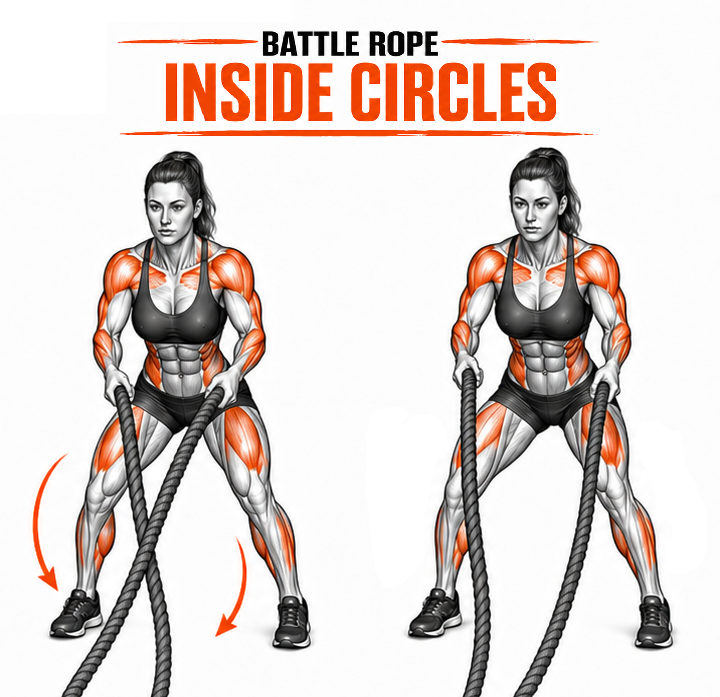
Battle Ropes Inside Circles
The deltoids circle both rope ends inward toward each other while the rotator cuff and grip steer the spirals and the heart rate climbs.
Level: Foundation
Primary: Shoulder
Secondary: Back - Upper Cardio Forearms
Movement: Compound
Tags: Rotational
Type: Aerobic (Cardio) Anaerobic Intervals (HIIT / Bootcamp / Circuit)
Equipment: Battle Ropes
Target muscles
The deltoids drive both arms in inward circles, with the anterior and medial heads working through the top of each rotation. The rotator cuff and forearm flexors steer the internal-rotation path and hold the grip as the ropes spiral, and the upper back stabilises the shoulder blades against the continuous pull. The non-stop circular work keeps the shoulders under tension and pushes the cardiovascular system, so the demand is both muscular endurance and conditioning.
How to perform
Setup
Take one rope end in each hand with light tension on the line. Stand shoulder-width with soft knees and a braced trunk, the chest tall and the shoulders set down and back. Hold your arms out in front at roughly waist to chest height with a slight bend in the elbows, your weight balanced through the midfoot, ready to begin circling the hands inward toward the midline.
Execution
Circle both hands inward toward each other, rotating the wrists in so the rope ends spiral toward the midline and the spirals travel down the rope. Keep both circles the same size and speed, driving from the shoulders with the elbows soft and the upper arms doing the steering. Maintain a steady, controlled rhythm so the spirals stay tight and uniform all the way to the anchor rather than fraying out. Hold your stance and brace the trunk throughout, letting the arms do the circling without the torso swaying side to side to help.
Common mistakes
- Making the two circles uneven in size or timing so the ropes fight each other.
- Letting the circles balloon outward and lose the inward, tight spiral pattern.
- Swaying the torso to help drive the circles instead of working from the shoulders.
- Easing off the grip so the rope ends flop and the spirals fall apart.
Progressions and regressions
Regress by shortening the interval or standing closer to the anchor to remove some load until the spirals stay tight. Progress by speeding the circles, lengthening the work bout, or pairing a set of inside circles directly with outside circles for one continuous block. Switching to a deeper athletic stance adds a lower-body and core demand, and splitting attention across two independently spiralling ropes sharpens the coordination challenge well beyond a plain alternating wave.
Programming notes
Use it in 20-40 second intervals for 3-6 rounds with matched rest, ideally back-to-back with outside circles so the shoulder is trained in both rotational directions. It fits a conditioning circuit or a shoulder finisher, and doubles as a warm-up to prime the shoulders before pressing. Keep the spirals honest in size rather than letting them shrink, and stop if the shoulder feels pinched in the internal-rotation path.