Advanced Tuck Planche
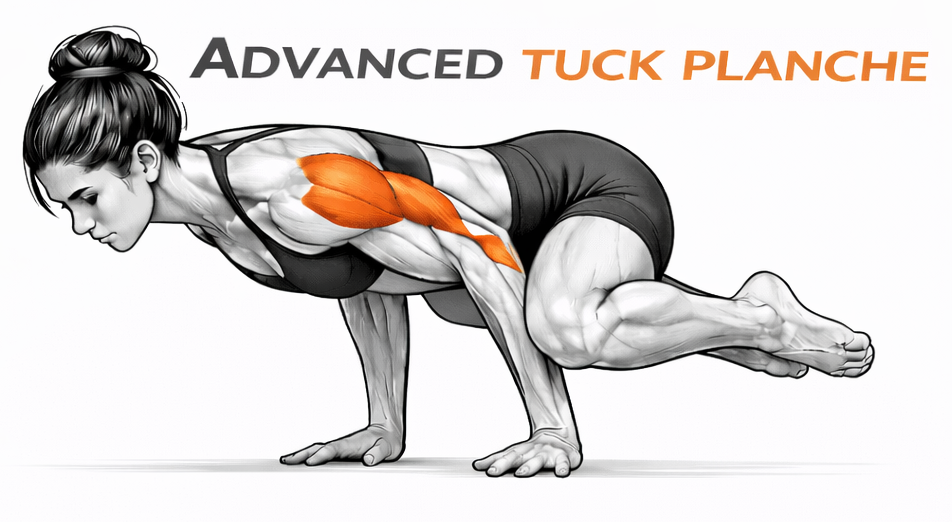
Elite static hold that bridges tuck and straddle planche — back parallel to the floor, knees pulled in, shoulders well forward of the hands.
Level: Elite
Primary: Shoulder
Secondary: Abs Chest Triceps
Movement: Isolation
Type: Functional Fitness (Obstacle & Hybrid) ISO Strength (Weight Lifting)
Equipment: Body Weight
Sports: Gymnastics
Target muscles
The front and lateral deltoids carry most of the load, working isometrically to keep the shoulders punched forward of the hands and to resist the lever your open hip creates. The serratus anterior holds the scapulae protracted around the ribcage; the lower traps fight to keep them depressed. Pectoralis major and the long head of the triceps contribute meaningfully, but it's the deep core — rectus abdominis, transverse abdominis, hip flexors — that often fails first, because the moment you open the hip angle the spine wants to dump into extension.
How to perform
Setup
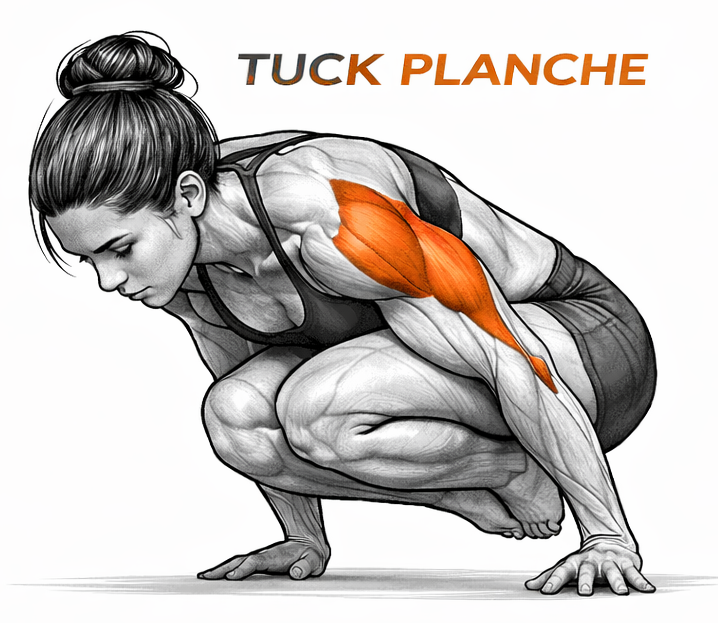
Start in a clean tuck planche on parallettes (or floor, if your wrists tolerate it) with your fingertips angled slightly outward. Knees pulled tight to the chest, hips piked, shoulders already forward of the hands so your bodyweight sits over your fingertips rather than your wrists. Lock the elbows. Brace the lats. If you can't hold a clean tuck planche for ten honest seconds, you have no business opening the hip — go back and earn the prerequisite.
Execution
From the tuck, slowly extend the hips until the back rotates toward parallel with the floor. The knees stay pulled in. Don't let the shoulders drift back to compensate — they should stay forward as the lever lengthens, with the load creeping further onto the front delts and serratus. Hold for three to five seconds, then either pike back to tuck or lower under control. The temptation is to let the lower back arch; resist by squeezing the glutes and pulling the ribs down toward the hips.
Common mistakes
- Shoulders drifting behind the hands as the hip opens — you've turned a planche progression into a frog stand variant and trained the wrong thing.
- Lumbar extension to fake the position. If your back is arched and your hips have dropped, you're not in advanced tuck.
- Skipping rungs from a shaky tuck planche straight to this. Build at least ten clean seconds of tuck before adding hip extension.
- Looking up at the ceiling — neck position drives upper-back stacking, and an extended neck shortens the hold dramatically.
- Training it when fresh shoulder fatigue is already present from pressing or handstand work earlier in the session.
Progressions and regressions
Regress with a band looped over a pull-up bar to offload part of the lever, decreasing band tension as the hold strengthens. To progress, open the legs to a straddle position once advanced-tuck holds reach ten to fifteen seconds. The straddle planche then opens further toward a horizontal split before you eventually close to a full planche. Most trainees rush this and stall for a year or two; don't. The reps you skip on the way up come due eventually.
Programming notes
Treat planche work as nervous-system training rather than muscle building. Three to five sets of three to five-second holds, with full recovery between sets, two or three sessions per week. Always place it early in the session, before pressing or any handstand work — never as a finisher when the shoulder girdle is already fried. If you're already accumulating heavy pressing volume in the same week, drop planche frequency to twice weekly to protect the elbows and front delts.