Disc Slider Reverse Plank Pull-Through
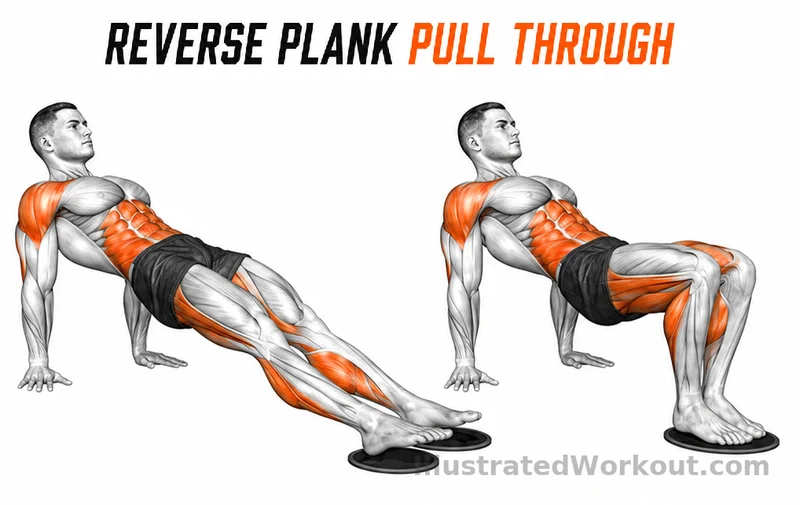
Holding a face-up reverse plank, the feet glide in and back out, loading the abs, glutes and hamstrings through a long straight-body lever.
Want a disc sliders core workout?
Our wizard builds one around your time, goal, and equipment in about two minutes. Free — no signup needed.
Make Me a Workout → Just did it? Track your setsHolding a face-up reverse plank, the feet glide in and back out, loading the abs, glutes and hamstrings through a long straight-body lever.
Level: Foundation
Primary: Abs
Secondary: Glutes Hamstrings Shoulder
Movement: Isolation
Tags: Core Stability
Type: Functional Fitness (Obstacle & Hybrid)
Equipment: Disc Sliders
Target muscles
Anchoring a straight-body reverse plank calls on the glutes and hamstrings to keep the hips high, while the abs brace to stop the midsection from folding. As the heels pull in, the hamstrings and glutes contract to bend the knees under load, and the shoulders, triceps and lats work statically to support the torso from behind. It is a strong posterior-chain and anti-sag core drill.
How to perform
Setup
Sit tall with the legs extended and a slider under each heel, hands planted behind the hips with fingers facing forward. Drive through the palms and heels to lift the hips into a long reverse plank, body straight from shoulders to feet. Squeeze the glutes and set the abs so the hips do not sag before you start.
Execution
Holding the hips high, pull both heels in toward the body by bending the knees, then extend them back out to the straight reverse plank without dropping the hips. Keep the movement smooth and driven by the hamstrings and glutes rather than by momentum. Press the shoulders down and keep the chest proud so the neck stays long. Breathe out as you pull in and stay tall through the whole range. If the hips begin to drop or the shoulders shrug, shorten the range and rebuild the position.
Common mistakes
- Allowing the hips to drop as the heels slide, which shifts the effort off the glutes and onto the shoulders and low back.
- Yanking the feet in with momentum instead of bending the knees under hamstring control.
- Rounding the upper back and shrugging the shoulders rather than staying tall and open.
- Cutting the outward slide short so the hips never return to a full, straight reverse plank.
Progressions and regressions
Regress by holding a static reverse plank, then adding a single-leg heel slide with the other foot grounded. Bending the arms to a forearm reverse plank eases the wrist load. Progress by slowing the tempo, pausing with the knees fully bent, or performing the pull-through on one leg at a time, which sharply raises the hamstring and glute demand on the working side.
Programming notes
Program it as a posterior-chain and core piece, eight to twelve reps for two to three sets, ideally after squats or hinges when the glutes are warm. It balances all the front-facing slider core work by loading hip extension, so it fits well in a full-body slider circuit. Skip it or use the forearm version if loaded wrist extension bothers you, and keep the hips honest rather than chasing reps.