Treadmill Reverse Mountain Climbers
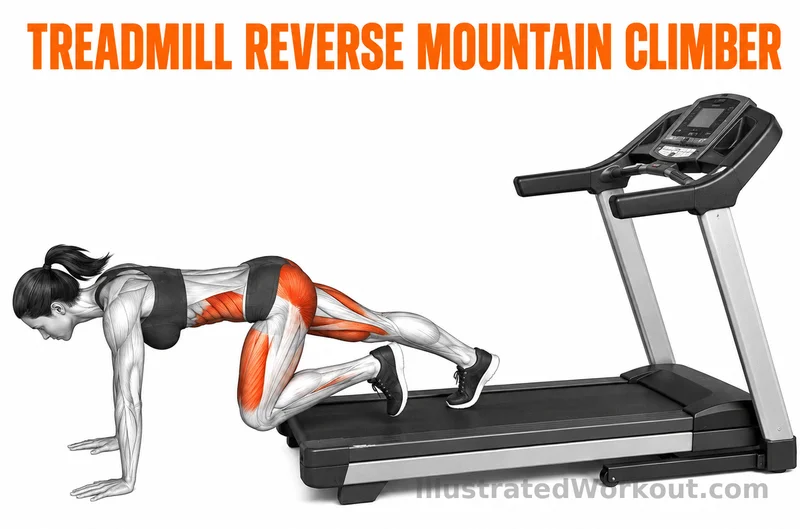
A face-up plank drill driving the feet along a slow belt, hammering the abs and hip flexors while the shoulders support the lifted hips.
Want a treadmill core workout?
Our wizard builds one around your time, goal, and equipment in about two minutes. Free — no signup needed.
Make Me a Workout → Just did it? Track your setsA face-up plank drill driving the feet along a slow belt, hammering the abs and hip flexors while the shoulders support the lifted hips.
Level: Intermediate
Primary: Abs
Secondary: Quads Shoulder
Movement: Compound
Tags: Core Stability
Type: Anaerobic Intervals (HIIT / Bootcamp / Circuit) Functional Fitness (Obstacle & Hybrid)
Equipment: Treadmill
Target muscles
In a face-up support with the hips lifted, the abs and hip flexors do the heavy lifting, driving each knee toward the chest and controlling its return. The glutes and hamstrings hold the hips high, the shoulders and triceps support the body on the arms, and the quads assist the knee drive. Held at pace, the continuous knee cycling drives the heart rate while the core braces against extension throughout.
How to perform
Setup
Set the belt to its slowest manual speed or switch the motor off so it only moves as you drive it. Sit facing away from the console, plant the hands behind you with fingers pointing back, and press the hips up into a reverse-plank tabletop. Brace the abs and set the shoulders stacked over the wrists.
Execution
Drive one knee up toward the chest, then return it and drive the other, running the feet along the belt in a steady reverse-climber rhythm. Keep the hips lifted and level the whole time so the glutes stay engaged and the low back stays protected. Move with control rather than flailing, keeping the shoulders supported and the chest tall. Breathe in rhythm with the knee drives. Match the pace to a slow or manual belt so the feet are never dragged out from under you.
Common mistakes
- Letting the hips sag toward the belt, which drops the load off the core and strains the low back.
- Setting a powered belt too fast so the feet are dragged back before the core can control them.
- Shrugging into the shoulders instead of pressing tall and keeping them stacked over the wrists.
- Rushing the knee drives so the hips bounce, losing the braced, level tabletop position.
Progressions and regressions
Regress to a stationary reverse-plank hold, or slow marching knee drives on the floor beside the machine before adding the belt. Progress by picking up the cadence, extending the interval, or adding a brief hold with one knee drawn in. Straightening and tapping the leg out before returning it increases the core and hip-flexor demand.
Programming notes
Program it as a core-and-conditioning station, twenty to forty second bouts for three to four rounds. It trains the abs and hip flexors under an anti-extension demand while adding a cardio element, fitting circuits and finishers. Keep the belt slow or manual and the hips lifted, and ease off if the wrists or shoulders complain about the face-up support position.