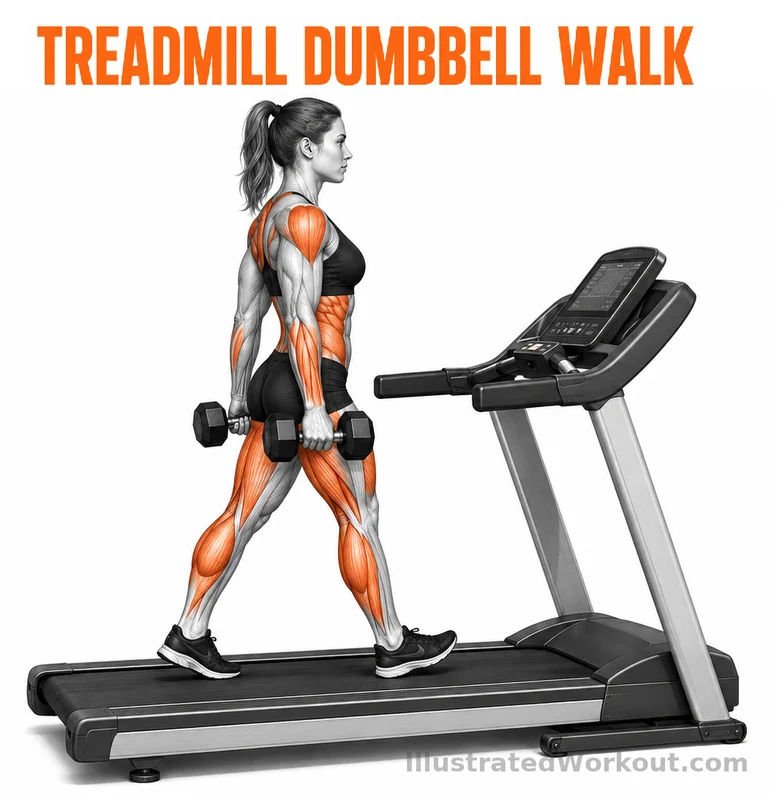
Treadmill Dumbbell Walk
A loaded march down the belt carrying dumbbells at the sides, taxing the grip, traps and legs while the braced trunk keeps posture tall.
Want a dumbbell full-body workout?
Our wizard builds one around your time, goal, and equipment in about two minutes. Free — no signup needed.
Make Me a Workout → Just did it? Track your setsA loaded march down the belt carrying dumbbells at the sides, taxing the grip, traps and legs while the braced trunk keeps posture tall.
Level: Foundation
Primary: Full Body
Secondary: Forearms Quads Traps
Movement: Compound
Tags: Loaded Carry
Type: Functional Fitness (Obstacle & Hybrid) Strength (Weight Lifting)
Equipment: Dumbbell Treadmill
Target muscles
Holding a dumbbell in each hand turns a simple walk into a full-body carry: the forearms and grip fight to keep hold of the handles, the traps and upper back resist the downward pull on the shoulders, and the abs brace to keep the ribcage stacked over the pelvis. The quads, glutes and calves drive each stride, so the legs and the whole posture chain work together under load throughout.
How to perform
Setup
Set a slow, controlled walking speed on the belt before picking up the weights, or straddle the belt to start. Grip a dumbbell in each hand, stand tall with the shoulders pulled back and down, and brace the abs. Let the arms hang directly at the sides with the wrists neutral and the chest lifted.
Execution
Walk with a smooth, deliberate stride, keeping the dumbbells still at your sides rather than letting them swing. Hold the shoulders packed back and down so the traps carry the load and the posture stays tall the whole way. Breathe steadily and grip the handles firmly throughout. Keep the steps even and the torso quiet, resisting any lean toward the weights. Because the hands are occupied, set a modest speed you can control confidently, and keep the eyes forward rather than down on the weights.
Common mistakes
- Letting the shoulders round forward under the load instead of keeping them packed back and the chest tall.
- Allowing the dumbbells to swing and the torso to sway, which wastes effort and unsettles the stride.
- Choosing a belt speed too quick to manage safely with the hands full.
- Shrugging the weights up tensely rather than letting the traps hold them with a long neck.
Progressions and regressions
Regress by lowering the weight, shortening the carry, or performing the walk on the floor before adding the belt. Progress by increasing the load, extending the time or distance, or switching to a single dumbbell for an anti-lateral-flexion suitcase carry. Carrying the weights overhead or in the front rack raises the core and shoulder demand considerably.
Programming notes
Use it to build grip, postural endurance and work capacity, two to four rounds of thirty to sixty seconds or a set distance. It fits conditioning circuits and accessory blocks, and the loaded-carry pattern carries over to daily lifting and sport. Start light while you learn to walk safely with the hands full, keep the speed modest, and step off carefully rather than dropping the weights on a moving belt.