Barbell Thruster
A front squat flowing straight into an overhead press — a brutally efficient full-body builder and conditioning staple.
Level: Advanced
Primary: Full Body
Secondary: Glutes Quads Shoulder Triceps
Movement: Compound
Tags: Explosive Push
Type: Anaerobic Intervals (HIIT / Bootcamp / Circuit) Hybrid Athletic Strength (Weight Lifting)
Equipment: Barbell
Target muscles
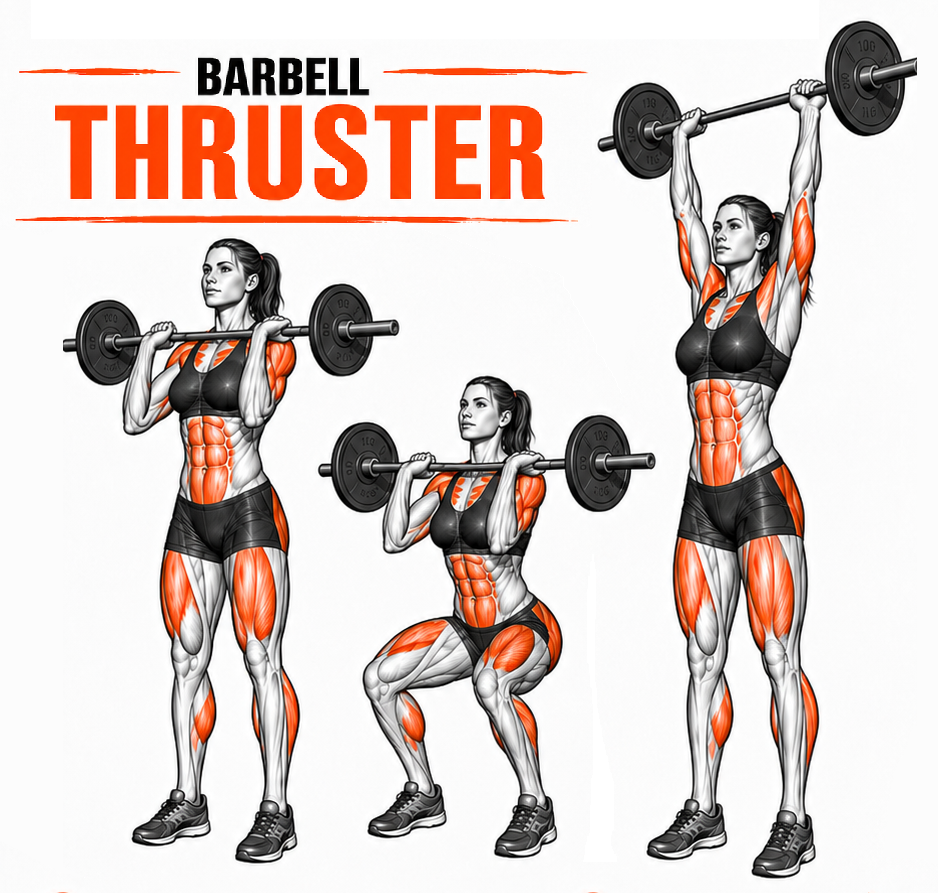
The thruster chains a front squat into a push press, so the quads and glutes drive the squat, the leg drive feeds momentum into the shoulders and triceps for the press, and the trunk braces to keep the bar path vertical. Because it's one continuous movement hitting nearly every major muscle, it spikes the heart rate and builds whole-body strength-endurance fast.
How to perform
Setup
Hold the bar in a front rack across the shoulders, elbows up, hands just outside the shoulders, feet shoulder-width, core braced.
Execution
Sit into a full front squat, keeping the elbows high and the torso upright. Drive hard out of the bottom and, as the hips and knees near extension, use that momentum to press the bar overhead to lockout. Lower the bar back to the front rack as you descend into the next squat, flowing the two movements together without pausing. Keep the bar path straight up and down.
Common mistakes
- Pressing before the legs finish, breaking the efficient transfer of momentum.
- Letting the elbows drop in the squat so the bar rolls forward off the shoulders.
- Leaning forward out of the bottom, turning the press into a strain on the lower back.
- Losing the brace and arching the lower back at lockout.
Progressions and regressions
Regress to separate front squats and push presses, or use dumbbells, to learn the timing. Progress by adding load, increasing reps for conditioning, or stringing them into circuits. Keep the front-rack mobility honest — wrist and shoulder tightness shows up here quickly.
Programming notes
Program it as a full-body strength or conditioning piece, 3-5 sets of 6-12 reps, or as part of metcon-style circuits. It's taxing — the cardiovascular cost is real — so manage volume and don't pair it with too many other compound lifts in one session. It's a favourite for building work capacity.