Bear Crawl Hold
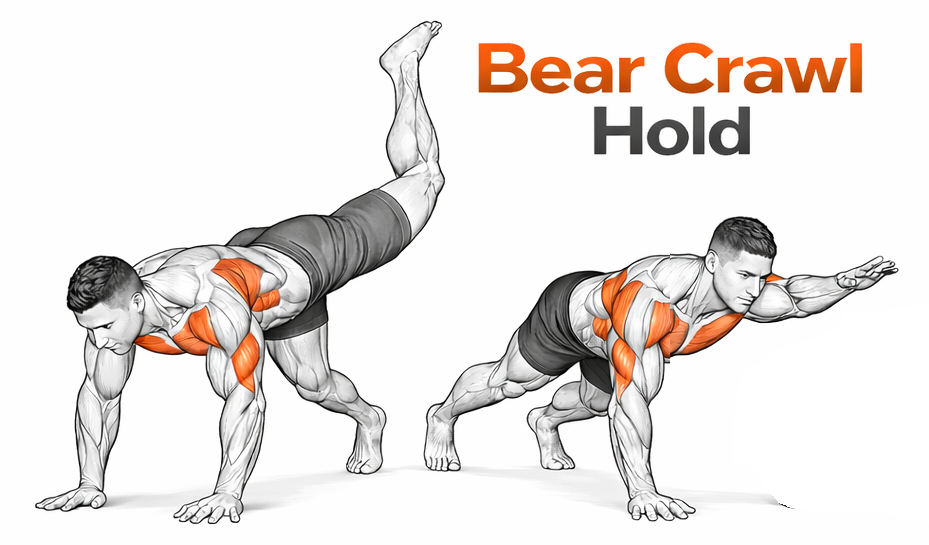
Static bear-crawl position — knees hovering an inch off the floor, hands under shoulders — a fundamental trunk and shoulder isometric.
Level: Beginner
Primary: Full Body
Secondary: Cardio
Movement: Isolation
Tags: Animal Movement
Type: Anaerobic Intervals (HIIT / Bootcamp / Circuit) Functional Fitness (Obstacle & Hybrid) ISO Primal Movments (Animal Flow-QMT Specifics)
Equipment: Body Weight
Sports: Gymnastics MMA Wrestling
Target muscles
The rectus abdominis and obliques work isometrically to keep the spine neutral against the suspended hip position. The deep core (transverse abdominis, multifidus) braces continuously. The anterior deltoids and serratus anterior hold the scapulae packed and the shoulders stable under load. The hip flexors and quadriceps hold the knees in the hovering position — they tire faster than people expect. The trapezius and rotator cuff stabilize the shoulders. Cardiovascular cost rises sharply after the first 20-30 seconds because the position is genuinely whole-body work, not a token movement.
How to perform
Setup
Start on all fours — hands directly under shoulders, knees directly under hips. Spread the fingers wide and press the palms into the floor to pack the shoulders. Tuck the toes under so the balls of the feet are loaded. Spine flat, head a natural extension of the neck.
Execution
Lift the knees one inch off the floor — that's it; they shouldn't be higher than that. Hold the position. The hips stay level with the shoulders (don't let them rise into a downward-dog), the spine stays flat, the gaze stays neutral. Breathe through the diaphragm — slow, controlled inhales and exhales. The instinct will be to hold the breath; resist it. Hold for the prescribed time. If the hips sag, the back arches, or the knees come back down, the hold is over.
Common mistakes
- Hips rising into a downward-dog shape, which makes the position easier by transferring load to the shoulders. Keep the hips level with the shoulders.
- Knees too high off the floor. One inch is the target — more turns the hold into a tabletop position that takes load off the trunk.
- Holding the breath through the entire set. Breathe in slow controlled cycles.
- Letting the head drop or the neck hyperextend. Keep the neck neutral, gaze toward the floor between the hands.
- Sagging through the lower back. The trunk must stay braced; if the back sags, the hold should end.
Progressions and regressions
Regress to a plank (forearms or hands) until you can hold a clean plank for sixty seconds. From there, the bear hold for 20-30 seconds at a time. To progress, add the bear crawl opposite-limb hold (extend opposite arm and leg simultaneously — much harder), the bear walk, or the bear-to-crab rollover for a flowing primal-movement sequence.
Programming notes
Excellent trunk warm-up before lower-body sessions, or as a finisher. 3-4 sets of 20-45 seconds, two or three times a week. The shoulder and trunk demand is moderate enough that this can be programmed alongside other trunk work without overlap concerns. Beginners benefit from short holds (10-15 seconds) with longer rest until the position is stable.