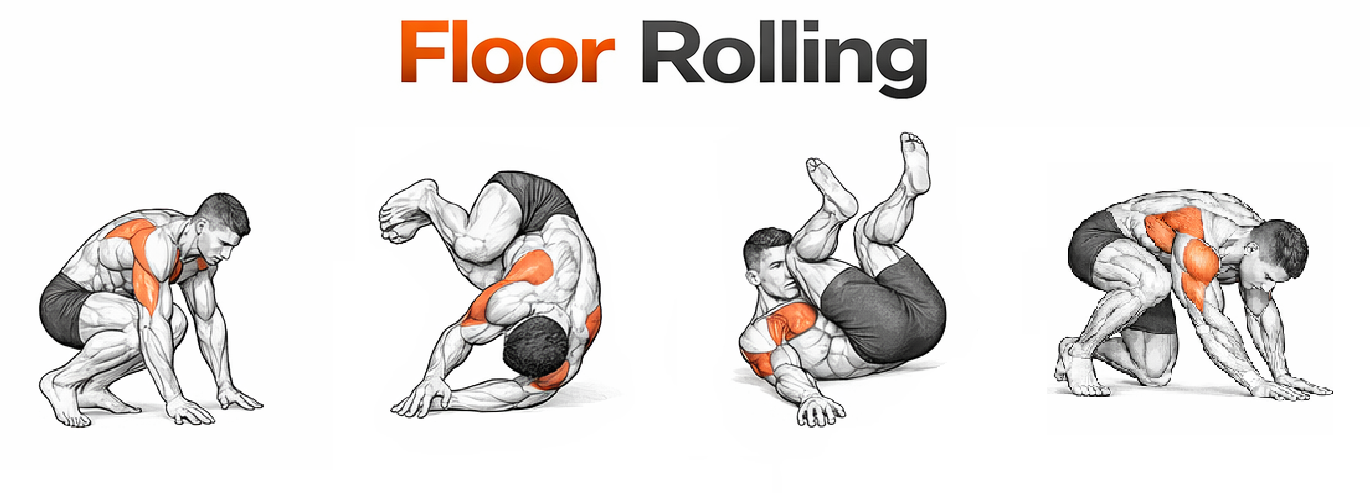
Floor Rolling
Controlled body roll across the floor — animal-flow movement that trains spinal articulation and trunk control.
Level: Beginner
Primary: Cardio Full Body
Movement: Isolation
Type: Flexibility (Dynamic Stretching) Primal Movments (Animal Flow-QMT Specifics)
Equipment: Body Weight
Sports: Gymnastics MMA Wrestling
Target muscles
The trunk muscles work continuously to control the rolling motion. The obliques drive lateral rotation. The deep core stabilizes the spine. The shoulders and hips work to coordinate the limbs through the roll. As a movement-quality drill, this trains spinal articulation and trunk control rather than building strength.
How to perform
Setup
Lie on your back with arms extended overhead, body in a straight line. Take a breath.
Execution
Initiate the roll from the trunk — small rotational movement that grows into a full body roll. Roll to your side, then to your stomach, keeping the body as straight as possible throughout. Reverse and roll back to your back. Continuous controlled motion. The arms and legs follow the trunk rather than leading.
Common mistakes
- Initiating the roll with the limbs. The trunk leads.
- Letting the body fold during the roll. Stay long and straight.
- Rushing. Slow controlled rolling is the training value.
- Doing it on a hard surface. Use a mat or carpeted floor.
- Forgetting to alternate directions.
Progressions and regressions
Regress to half-rolls (rolling only to the side, not all the way over) until the trunk control is solid. To progress, work the roll with a hollow body position, add a load (kettlebell held in the hands), or chain with other animal-flow movements.
Programming notes
Movement-quality work. 2-3 sets of 4-6 rolls (2-3 each direction), two or three times a week. Excellent warm-up movement before lower-body sessions or as recovery-day work.