Bear to Crab Rollover
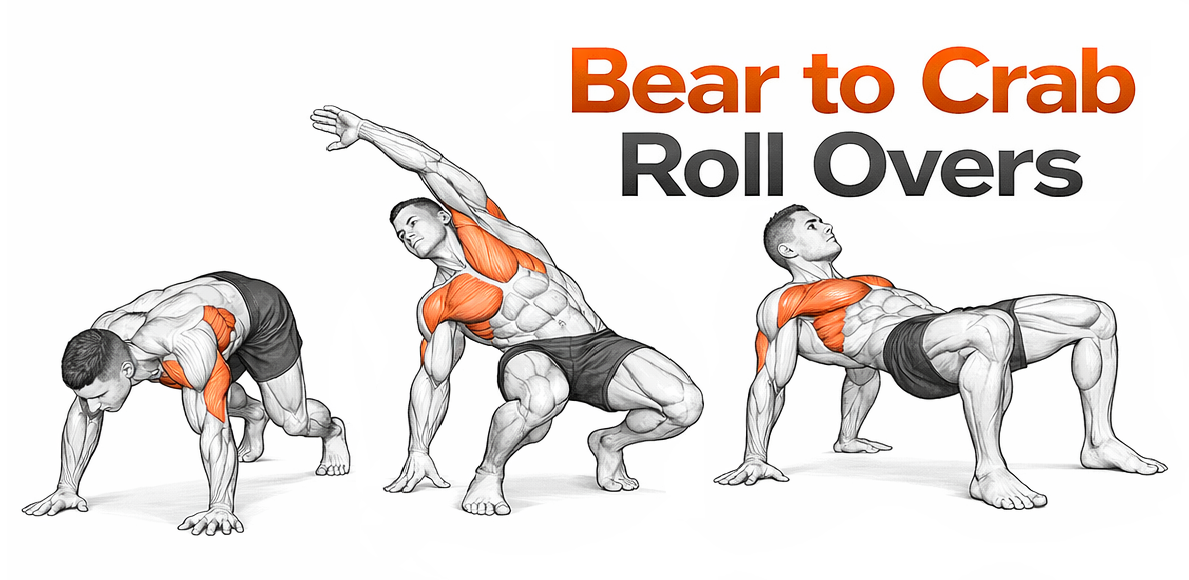
Flowing transition from a bear crawl to a crab walk (belly up) and back — primal-movement work for trunk control and shoulder mobility.
Level: Beginner
Primary: Cardio Full Body
Movement: Compound
Tags: Animal Movement
Type: Anaerobic Intervals (HIIT / Bootcamp / Circuit) Functional Fitness (Obstacle & Hybrid) Primal Movments (Animal Flow-QMT Specifics)
Equipment: Body Weight
Sports: Boxing MMA
Target muscles
The trunk muscles work continuously through the rotation — obliques, rectus abdominis, deep core. The shoulders, particularly the rotator cuff and posterior deltoids, transition through a huge range of motion under load. The serratus anterior packs the scapulae through both positions. The glute maximus drives the hip extension at the top of the crab position. The triceps support the crab position. Hip flexors of the bear position load eccentrically as you roll. This is whole-body coordination and mobility work disguised as exercise.
How to perform
Setup
Start in a bear crawl position — hands under shoulders, knees hovering one inch off the floor. Pack the shoulders, brace the trunk. Take a breath.
Execution
Roll your body to one side — the hand and knee on the rolling side lift off, and the body rotates so you're now belly-up in a crab walk position (hands and feet on the floor, hips lifted off the ground). The trunk muscles control the rotation; don't just flop over. From the crab, hold briefly — hips up, chest open. Reverse the rotation back to bear crawl. The hips stay off the ground through the entire transition. Switch direction on each rep or alternate as the program prescribes.
Common mistakes
- Letting the hips touch the floor mid-rotation. The trunk should hold the hips elevated; sitting down loses the training value.
- Rushing the rotation. Smooth, controlled — feel the transition rather than throwing yourself through it.
- Hips dropping in the crab position. Push them up; the crab is a hip-extended position, not a sitting one.
- Locking the elbows hard in the crab. Slight bend protects the elbow joint from compressive load.
- Forgetting to switch the rolling direction. Alternate sides — both rotations need to be trained.
Progressions and regressions
Regress to the bear crawl hold and the crab walk hold as separate positions until each is stable. Then practice slow controlled side-rotations without going all the way over. To progress, work the bear-to-crab switch through (passing one leg under the body during the rotation), chain rotations with bear crawls and ape walks, or add a static hold in each position before transitioning.
Programming notes
Excellent dynamic warm-up movement (3-5 reps per side) or as a flow piece in an animal-flow session. As conditioning, 30-60 seconds of continuous bear-to-crab flow per round, 3-5 rounds, two or three times a week. The shoulder and trunk mobility carry over to overhead work, throwing sports, and general movement quality. Use as a recovery-day primer when you don't want load but want movement.