Mini Trampoline Twist Bounce
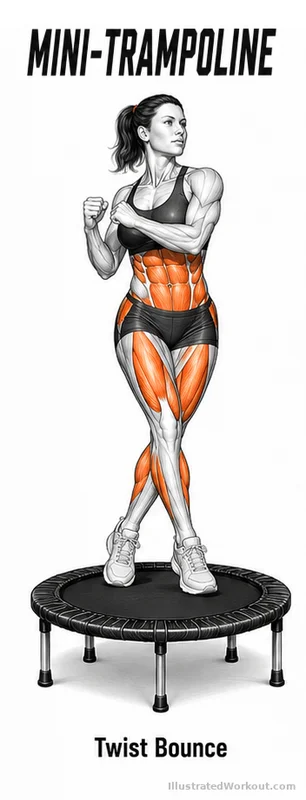
A bouncing torso twist that rotates the hips one way and the shoulders the other on each rebound, raising the heart rate while working the obliques.
Want a mini trampoline conditioning workout?
Our wizard builds one around your time, goal, and equipment in about two minutes. Free — no signup needed.
Make Me a Workout → Just did it? Track your setsA bouncing torso twist that rotates the hips one way and the shoulders the other on each rebound, raising the heart rate while working the obliques.
Level: Beginner
Primary: Cardio
Secondary: Abs Calves
Movement: Isolation
Tags: Rotational
Type: Aerobic (Cardio)
Equipment: Mini Trampoline
Target muscles
The obliques do the defining work, rotating the hips and lower body one way while the upper body counter-rotates, and the rectus abdominis braces to control the twist. The calves and quadriceps manage the springy contacts on the mat as the feet swivel, and the hip stabilisers keep the knees tracking safely through the rotation. The continuous twist-and-bounce rhythm keeps the cardiovascular system working while adding gentle rotational movement the straight bounces lack.
How to perform
Setup
Stand over the centre of the mat with feet together or close, knees soft and weight on the balls of the feet. Brace the core and set the chest tall, letting the arms bend and swing across the body. Fix the gaze forward so the head stays relatively still while the torso rotates beneath it.
Execution
Bounce lightly and let the hips and feet twist to one side while the shoulders and arms swing the opposite way, then reverse the rotation on the next rebound. Keep the twists smooth and controlled, driving the rotation from the obliques rather than throwing the arms wildly. Land softly through the balls of the feet as the mat cushions each contact, and stay centred so the swivelling never carries you toward the frame. Keep the torso tall and the pace even, breathing steadily as the hips and shoulders wind and unwind in an easy rhythm.
Common mistakes
- Throwing the arms to create the twist instead of rotating from the obliques and letting the arms follow.
- Twisting the knees under load rather than letting the feet pivot so the joints stay safe.
- Landing flat and heavy instead of staying light and springy on the balls of the feet.
- Drifting off the mat's centre as the swivelling movement carries you sideways.
Progressions and regressions
Regress by shrinking the range to a small, gentle twist with a low bounce, or holding a stability bar while you learn the rhythm. Progress by widening the rotation, quickening the tempo, or adding a light medicine ball held at the chest to give the obliques a little more to control through each twist.
Programming notes
Use it as a warm-up that mobilises the trunk or as a gentle rotational station in a rebounder circuit, forty-five to ninety seconds at an easy pace. It adds trunk rotation to a routine dominated by up-and-down bounces, keeping the obliques involved. Keep the pivot in the feet rather than the knees, and stay controlled; those chasing rotational power should choose a loaded chop or twist instead.