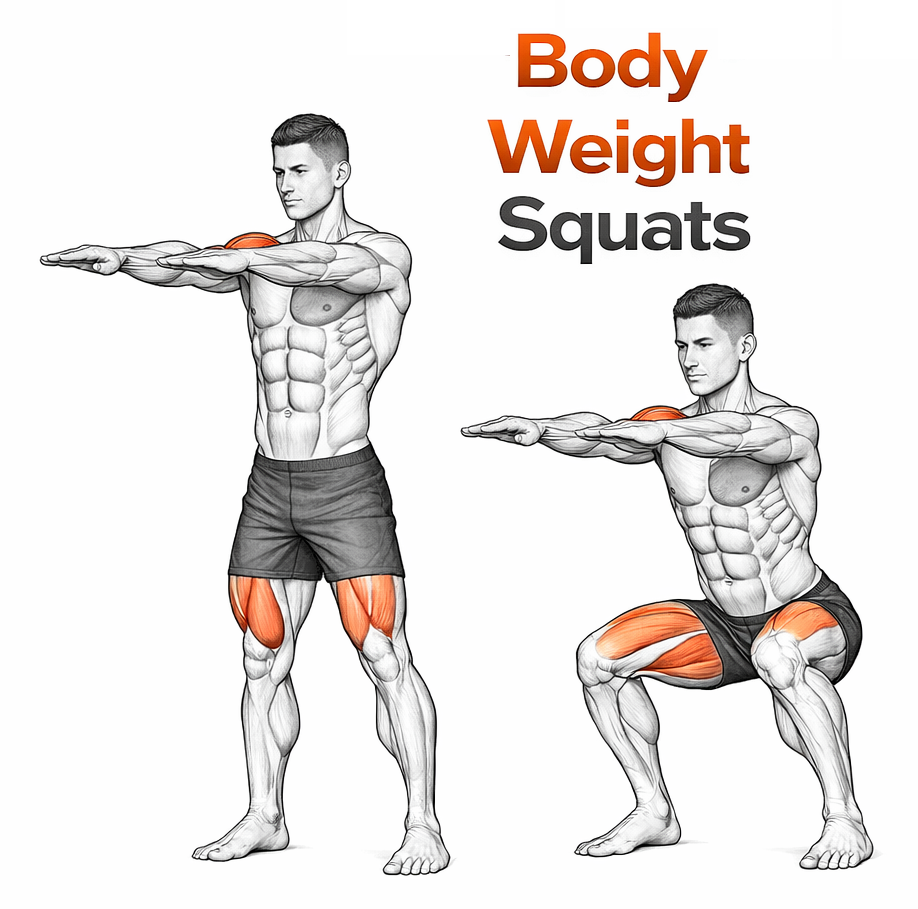
Body Weight Squats
Unloaded bodyweight squat — the fundamental human movement pattern that builds quad and hip mobility before any bar work.
Level: Beginner
Primary: Cardio Quads
Secondary: Glutes Hamstrings
Movement: Compound
Tags: Squat
Type: Functional Fitness (Obstacle & Hybrid)
Equipment: Body Weight
Sports: Basketball Football Rugby Track and Field Volleyball
Target muscles
The quadriceps drive knee extension out of the bottom. The gluteus maximus drives hip extension. Hamstrings co-contract for knee stability. The gluteus medius works to keep the hips from collapsing. The trunk muscles brace lightly against gravity. The calves and the anterior shin muscles work isometrically to keep the feet stable. Without load, this is more of a mobility, pattern, and conditioning lift than a strength builder — but it's the prerequisite for every loaded squat that follows.
How to perform
Setup
Stand with feet shoulder-width apart, toes slightly turned out (10-20 degrees). Arms can hang at the sides, come up to a goblet position, or extend straight forward for balance. Take a breath in.
Execution
Push the hips back slightly and break at the knees and hips together. The knees track over the second toes. Descend until the hip crease drops below the top of the knee — the standard depth marker. Keep the chest up and the spine neutral throughout. Drive through the full foot to stand, finishing with hips extended. Don't pause unnecessarily — bodyweight squats flow naturally rep to rep. Breathe in on the descent, exhale on the way up.
Common mistakes
- Knees collapsing inward at the bottom. Drive them out over the toes actively.
- Lifting the heels off the floor. If you can't keep the heels down at depth, work on ankle mobility before adding load — or wear shoes with a small heel raise.
- Rounding the lower back at the bottom. The lumbar stays in a neutral arch; rounding under bodyweight is fine occasionally but becomes a problem under load.
- Squatting too narrow with feet straight forward. The slight toe-out and shoulder-width stance is more natural for most people; force a narrower stance only with specific goals.
- Cutting depth as the set wears on. Hit depth or count it as a fail.
Progressions and regressions
Regress to box squats (sitting to a target depth on a chair or box) if depth is a problem. To progress, add a tempo (3-second descent), pause squats (3-second pause at depth), goblet squats (kettlebell or dumbbell at chest), and eventually loaded barbell squats. The pistol squat (single-leg full squat) is a long-term bodyweight progression that requires significant flexibility and balance.
Programming notes
Excellent warm-up movement (one or two sets of 10-15 to prime the legs before barbell work), conditioning piece (30 seconds on / 30 seconds off intervals), or skill movement for beginners (3-4 sets of 12-20 reps). For deconditioned beginners, the bodyweight squat is the entire lower-body program for the first few weeks; build the pattern and the mobility before adding load.