Stair Climber Sprint
Fast, high-cadence stair sprints that torch the quads, glutes and calves while driving the heart rate deep into the red.
Want a stair climber conditioning workout?
Our wizard builds one around your time, goal, and equipment in about two minutes. Free — no signup needed.
Make Me a Workout → Just did it? Track your sets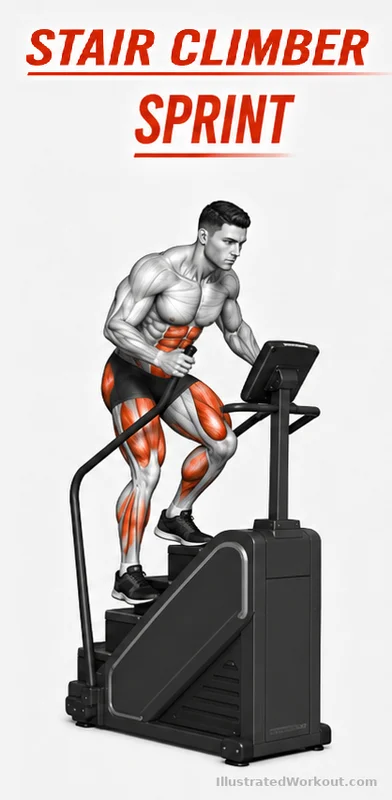
Fast, high-cadence stair sprints that torch the quads, glutes and calves while driving the heart rate deep into the red.
Level: Intermediate
Primary: Cardio
Secondary: Calves Glutes Quads
Movement: Isolation
Type: Aerobic (Cardio) Anaerobic Intervals (HIIT / Bootcamp / Circuit)
Equipment: Stair Climber
Target muscles
Sprinting up the moving stairs fires the quadriceps to slam each knee straight at speed, the gluteus maximus to explode the hip up onto the next step, and the calves to snap off the forefoot with every fast stride. The hamstrings add to the hip drive and the core works overtime to keep the torso stacked as the cadence climbs. This rapid, repeated single-leg power output drives the heart rate and the legs' anaerobic capacity toward their limit within seconds.
How to perform
Setup
Warm up first with a few easy minutes of steady climbing to prime the legs and lungs. Stand tall with a light touch on the rails for balance, chest up and hips beneath the shoulders. Set the speed to a fast setting for the work bursts, high enough that keeping up is a genuine fight, and brace the core ready to attack.
Execution
Drive up the stairs as fast as you can control, planting full, powerful steps and pushing hard through the heel and glute on each one. Push the effort to an eight or nine out of ten, into the zone where breathing is desperate and the legs flood quickly. Keep the torso tall and stay off the rails as much as balance allows so the legs do the work, and pump the arms to help the rhythm. Hold the burst for the set window, then drop the speed and step easy to recover before the next. Those slow recovery steps let the heart rate fall enough to hit the following interval with real power.
Common mistakes
- Hauling the body up by the handrails, which turns a leg sprint into an arm-assisted cheat and cuts the intensity.
- Skipping steps recklessly at high speed, which risks a stumble and a shin or ankle knock.
- Bouncing on the toes in tiny frantic steps rather than driving full, powerful strides.
- Cutting the recovery steps short, leaving the legs flooded so each sprint gets slower and sloppier.
Progressions and regressions
Regress by shortening the work bursts, lengthening the recovery, or building the base with Stair Climber Moderate first. Progress with longer intervals, shorter rest, higher speeds, or two-at-a-time power steps during the surges. Releasing the rails through the sprints raises the balance and core demand, and tighter work-to-rest ratios push the conditioning steeply.
Programming notes
Slot it in as high-intensity interval conditioning once or twice a week, for example ten rounds of twenty to thirty seconds hard against sixty to ninety easy. It hammers the legs and cardio system hard while avoiding the ground impact of hill sprints, which suits athletes wanting leg-driven intervals. Keep it well clear of heavy squat and lunge days and program it fresh; the leg and cardiovascular cost is high, so it is not a daily tool and needs real recovery.