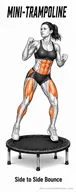
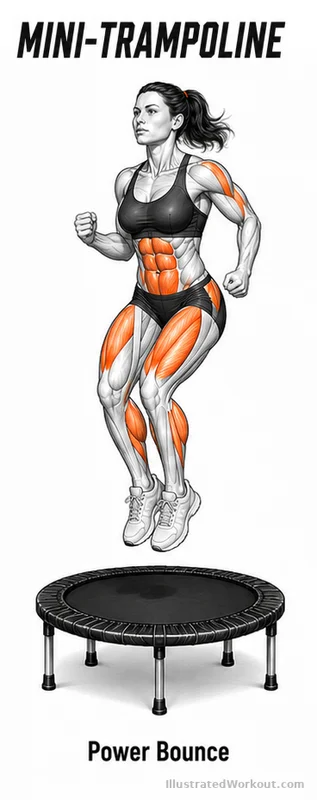
Mini Trampoline Power Bounce
A driving, higher-amplitude rebound that pushes the feet hard into the mat for bigger bounces, lifting intensity while the surface cushions the landing.
Want a mini trampoline conditioning workout?
Our wizard builds one around your time, goal, and equipment in about two minutes. Free — no signup needed.
Make Me a Workout → Just did it? Track your setsA driving, higher-amplitude rebound that pushes the feet hard into the mat for bigger bounces, lifting intensity while the surface cushions the landing.
Level: Foundation
Primary: Cardio
Secondary: Calves Quads
Movement: Isolation
Type: Aerobic (Cardio) Anaerobic Intervals (HIIT / Bootcamp / Circuit) Plyometric
Equipment: Mini Trampoline
Target muscles
The calves and quadriceps supply the force, pressing hard into the mat to launch each bigger rebound, while the glutes extend the hips to add drive. The hamstrings and core stabilise the flight and the tall landing, and the ankle stabilisers manage the higher forces returning through the mat. Because each rebound is more forceful than a gentle bounce, the cardiovascular and muscular demand both climb, though the mat still absorbs the shock a hard floor would deliver.
How to perform
Setup
Stand over the centre of the mat with feet hip-width, knees soft and weight in the mid-foot. Brace the trunk firmly and set the chest tall. Let the arms hang ready to swing so they can help drive the bounce upward once you begin.
Execution
Press down firmly through the whole foot to push into the mat, driving into a taller, more powerful rebound and swinging the arms up to assist. Meet the mat with soft knees on the way down and immediately load the next bounce, keeping a strong, rhythmic push-pull with the surface. Stay centred on the mat and land through the balls of the feet with control. Keep the torso stacked and the core braced so the extra force does not tip you forward. Breathe with the rhythm and drive each bounce with intent rather than drifting into a passive bob.
Common mistakes
- Passively bobbing instead of actively pressing into the mat to earn a powerful rebound.
- Landing stiff-legged, which lets the higher force jar the knees rather than absorbing softly.
- Losing the tall torso and pitching forward as the bounces get bigger.
- Drifting toward the frame where a forceful landing is far less forgiving.
Progressions and regressions
Regress to a standard bounce with less drive, or hold a stability bar while you learn to press into the mat safely. Progress by increasing the height and force of each rebound, adding a tuck or a knee drive at the top, or alternating powerful bounces with jumping jacks to keep intensity high across an interval.
Programming notes
Use it as a higher-intensity conditioning station, twenty to forty-five seconds of driven bounces followed by rest. It bridges gentle rebounding and true plyometric jumps, adding real cardio and lower-leg work while the mat cushions the load. Keep every landing controlled, and back off the height if the knees or lower back complain, since the added force is what separates it from an easy bounce.