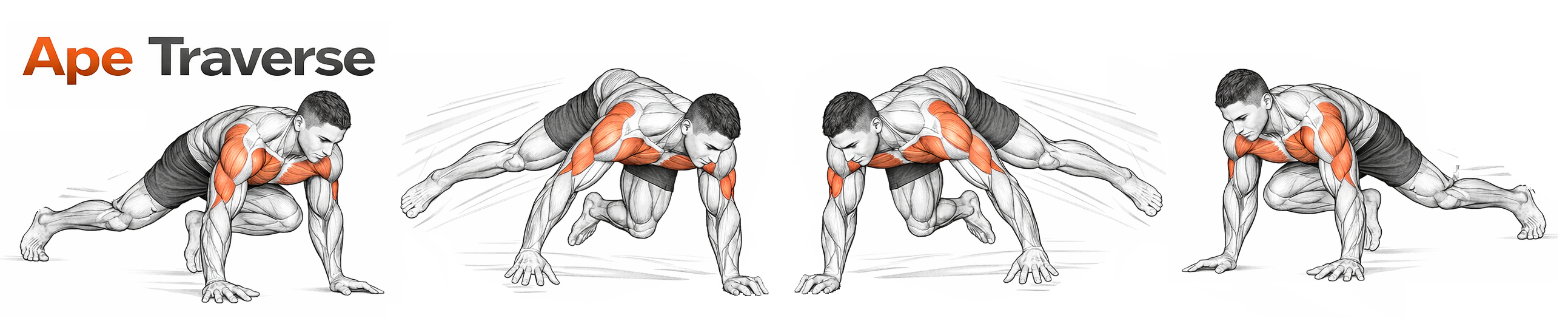
Ape Traverse
Lateral hand-and-foot crawl from a deep squat — a primal-movement staple for hip mobility, shoulder stability, and conditioning.
Level: Beginner
Primary: Cardio Full Body
Movement: Compound
Tags: Animal Movement
Type: Functional Fitness (Obstacle & Hybrid) Primal Movments (Animal Flow-QMT Specifics)
Equipment: Body Weight
Sports: Gymnastics MMA Wrestling
Target muscles
This is a true full-body movement, but the unsung work happens at the hips and shoulders. The quads and glutes hold a deep squat under load; the adductors and hip flexors fire continuously to control the lateral weight shift. Up top, the anterior deltoids and serratus anterior keep the shoulders packed during ground contact, and the triceps brace each support phase. The trunk works isometrically to keep the spine from collapsing into the squat. Cardio cost is real once the pace picks up — your heart rate climbs as the large muscles cycle continuously.
How to perform
Setup
Drop into a deep squat — heels flat if mobility allows, butt as close to the calves as you can manage. Hands on the floor between or just outside the feet, fingers pointing forward. The hips stay low through the entire traverse; if you find yourself standing up between reps, you've turned this into something else.
Execution
Lead with the hands: shift your weight onto your feet briefly and step both hands a foot or two to the right. Then shift weight onto your hands and walk both feet to follow. Hands first, feet second, low and continuous. Keep the chest open and look forward, not down. Move at a pace that lets you breathe; this should burn in the legs and shoulders by the time you've covered five or six meters in one direction. Reverse and come back. Smoothness matters more than speed.
Common mistakes
- Standing up between reps to give the legs a break — defeats the entire point. Stay in the squat.
- Letting the knees collapse inward as you weight one leg. Drive them out actively, the same way you would in a barbell squat.
- Rounding the upper back into a hunched position. Stay open through the chest; the hips, not the spine, do the work.
- Dragging the hands instead of clearly picking them up — the brief float teaches shoulder stability under load.
- Letting the hips rise just a few inches over the course of a long set. Check yourself periodically and reset.
Progressions and regressions
Regress by spending time in a static deep squat first — three or four ninety-second holds a day for a week or two often unlocks enough range for the traverse. Once mobile enough, walk only with the hands and pivot the feet (no full step) as a halfway version. To progress, traverse over uneven surfaces, add a weighted vest, or chain it with other primal-movement transitions (bear crawl, crab walk, beast-to-crab) for an animal-flow style sequence.
Programming notes
Use as a warm-up movement (one or two passes of 5-10 meters each direction), as conditioning intervals (30-60 seconds of continuous traversing per round), or as a low-impact recovery-day primer. It pairs well with mobility work since it actively grooves the deep-squat position. Avoid programming it heavy the day after a hard squat or deadlift session — the deep flexion under load can aggravate already-cooked knees and hips.