Handstand to Bridge
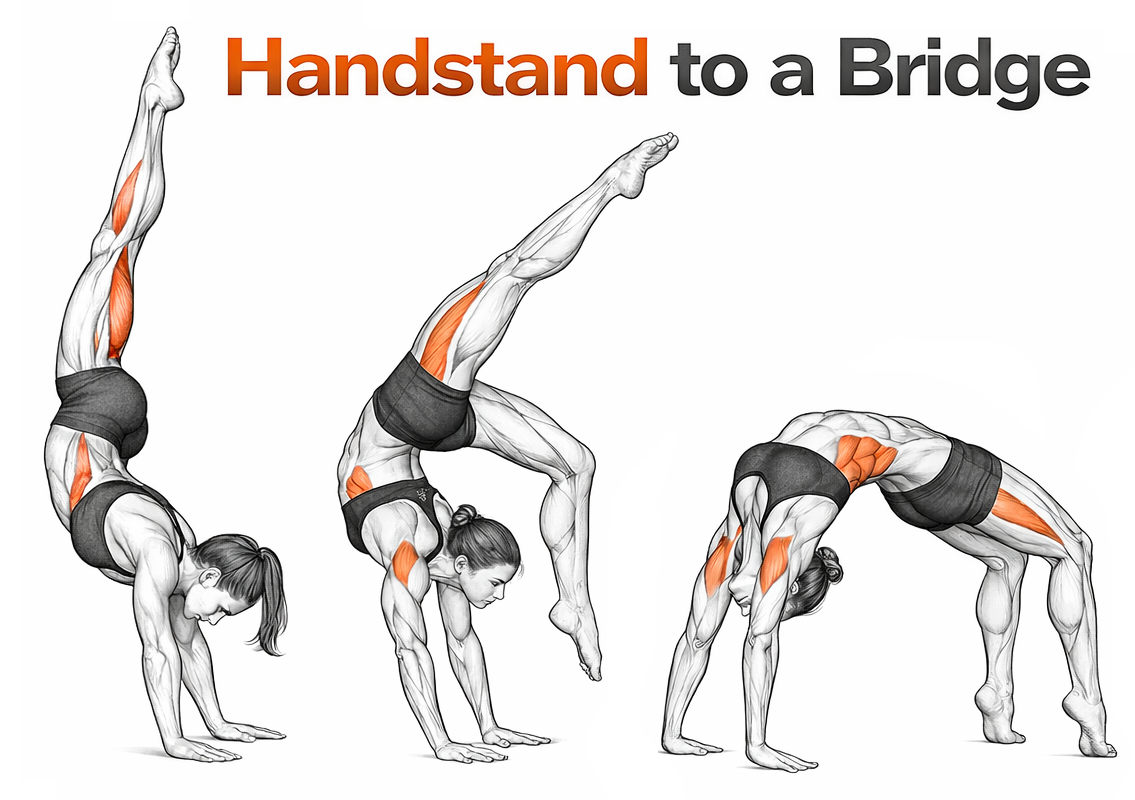
Handstand against a wall lowering into a bridge — gymnastic movement combining inversion, shoulder mobility, and back arch.
Level: Elite
Primary: Full Body Hamstrings
Movement: Compound
Type: Flexibility (Dynamic Stretching) Functional Fitness (Obstacle & Hybrid) Light Activity
Equipment: Body Weight
Sports: Gymnastics
Target muscles
The shoulders and triceps hold the handstand. The lats and chest work through their flexibility ranges as the body transitions. The spinal erectors and glutes hold the bridge arch. The hamstrings stretch and contract through the descent. The hip flexors hold the bridge position. As a gymnastic flow, this connects two demanding positions through controlled movement.
How to perform
Setup
Kick up into a handstand against a wall. Pack the shoulders. Body in a straight line.
Execution
Slowly lower one leg at a time toward the floor behind you while maintaining a controlled arch in the back. As the feet reach the floor, shift into a bridge position with both hands and feet on the ground. Pause briefly in the bridge. To return, kick back up to the handstand by reversing the motion (advanced) or stand up (most lifters).
Common mistakes
- Letting the body collapse mid-transition. Control every inch of the descent.
- Not warming up the shoulders and back enough beforehand. The spine and shoulder mobility demand is real.
- Banging the feet down. Soft landings.
- Doing it cold.
- Not having a wall or spotter for safety.
Progressions and regressions
Regress to the handstand and bridge as separate exercises until each is solid. Then add the controlled descent. To progress, work the handstand-to-bridge without the wall, or chain with backbend kickovers.
Programming notes
Skill work. 3-5 attempts per session, twice a week. Build the prerequisites (handstand hold, bridge hold, thoracic extension) on every session.