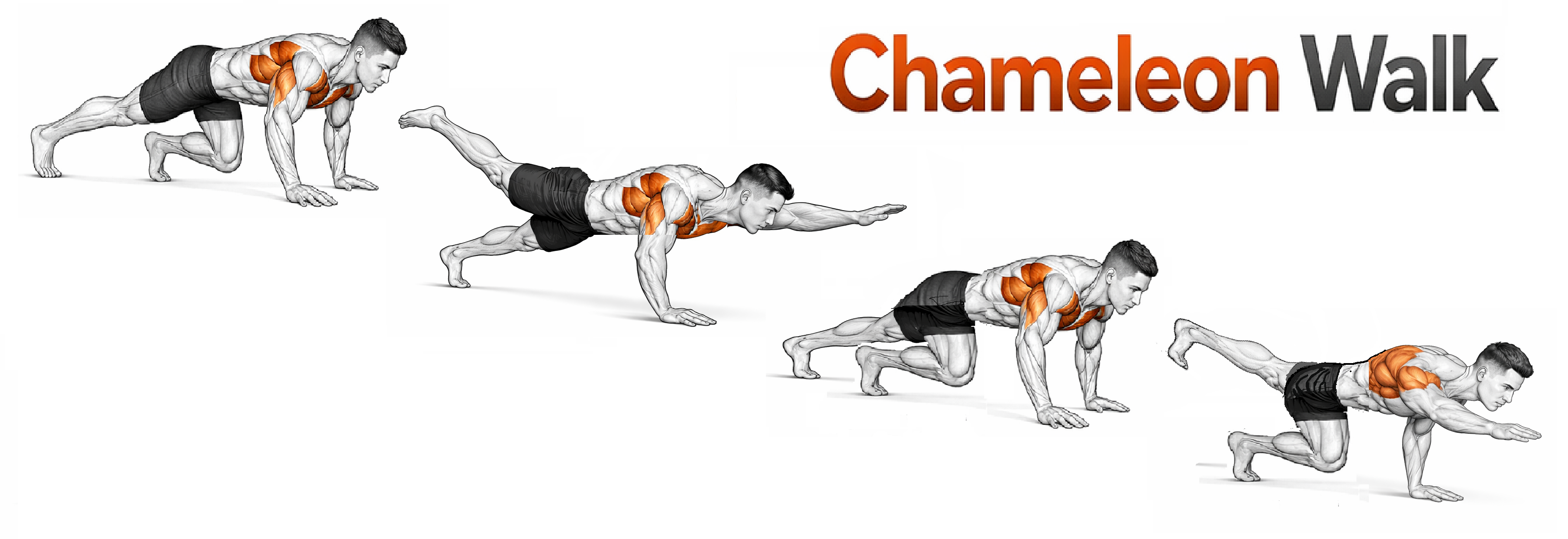
Chameleon Walk
Slow low-crawl with one hand reaching far forward and the opposite foot stepping up to meet it — coordination, mobility, and shoulder stability work.
Level: Beginner
Primary: Cardio Full Body
Movement: Compound
Tags: Animal Movement
Type: Functional Fitness (Obstacle & Hybrid) Primal Movments (Animal Flow-QMT Specifics)
Equipment: Body Weight
Sports: Gymnastics MMA Wrestling
Target muscles
The trunk works continuously to keep the spine stable while the limbs reach asymmetrically. The hip flexors of the stepping leg lift the foot up to meet the reaching hand. The glute medius of the planted leg stabilizes the hip during the asymmetric loading. The anterior deltoids and serratus of the reaching arm work through a long range. The hip mobility of the planted leg is challenged by the deep flexion the position requires. This is a movement-quality drill, not a strength-building lift — the value comes from the awareness it develops.
How to perform
Setup
Drop into a low crawl position — chest close to the floor, hips low, knees bent and hovering. Hands flat on the floor in front. Take a breath. Move slowly.
Execution
Reach one hand far forward — let the arm extend fully. As the hand lands, step the opposite foot up to a position near or alongside the same-side hand. Plant the foot, then reach the other hand forward. Step the now-opposite foot up. The body stays low through the whole walk — chest just above the floor, hips just above the floor. Move deliberately, like a chameleon stalking. Continue for the prescribed distance.
Common mistakes
- Standing up between steps. The body stays low throughout.
- Rushing the reach. The slow deliberate pace is the entire point.
- Same-side hand and foot moving together. The cross-pattern (opposite hand and foot) is what trains the trunk control.
- Forgetting to alternate sides. Each reach goes with the opposite-side step.
- Pushing through pain in the hips or shoulders. The deep position demands mobility that not everyone has; back off if anything pinches.
Progressions and regressions
Regress to a slower bear crawl (knees higher off the floor, less hip-flexion demand) until the position is comfortable. To progress, lower the position further (chest closer to the floor), reach further forward on each step, or chain with crouching tiger walks for a primal-flow sequence.
Programming notes
Excellent for hip-mobility-and-trunk-control work, especially for athletes whose sports demand low positions (martial arts, wrestling, climbing). Two or three passes across the gym in a warm-up, or 30-60 seconds per round in a conditioning circuit. Two or three times a week. The hip flexion load accumulates over long sessions; rotate with other primal movements.