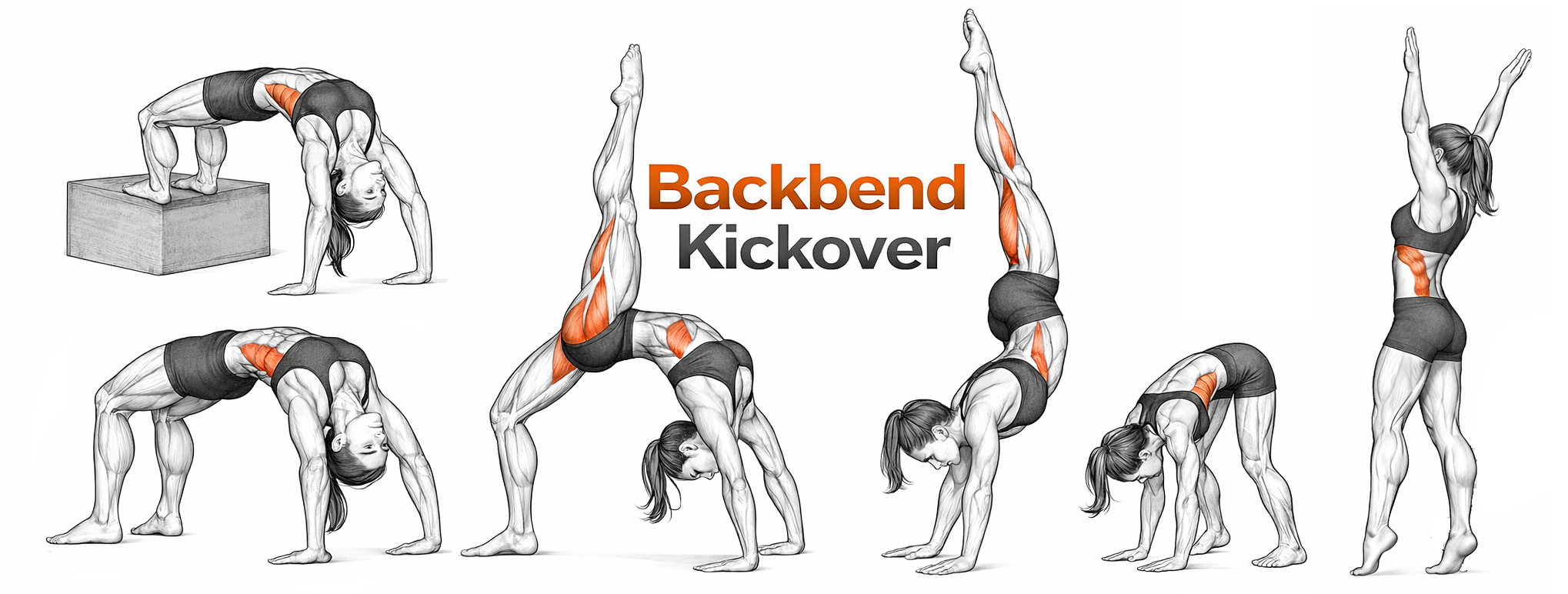
Backbend Kickover
Gymnastic-style backbend into a kick-over to standing — demands serious thoracic extension, shoulder mobility, and overhead control.
Level: Elite
Primary: Full Body
Movement: Isolation
Type: Flexibility (Dynamic Stretching) Functional Fitness (Obstacle & Hybrid)
Equipment: Body Weight
Sports: Football MMA Rugby Soccer
Target muscles
This is whole-body work, but the loads concentrate at the shoulders and the thoracic spine. The latissimus dorsi and pectoralis major must yield enough length to allow a true overhead bridge; the rhomboids, lower traps, and rear deltoids work hard to support the inverted shoulder position. The glutes and hamstrings fire continuously to lift and drive the kicking leg, and the spinal erectors hold the bridge shape against gravity. The hip flexors and quads of the kicking leg generate the momentum that takes you over.
How to perform
Setup
Spend ten to fifteen minutes warming the spine before attempting this — cat-cows, seal stretches, kneeling thoracic extensions over a foam roller, and at least one practice bridge held for thirty seconds. Stand with feet hip-width apart. Pick a strong leg and a kicking leg and decide before you start; switching mid-movement is how people land on their heads.
Execution
Reach the arms overhead and back, then arch backward into a bridge, eyes tracking the ceiling and then the floor behind you as the hands land. Kick the lead leg up and over while pushing strongly through the arms — the leg's momentum, not arm strength, is what gets you upright. The trailing leg follows the kicking leg over and lands a step ahead of the take-off position. Stand tall to finish. The whole thing should be one continuous motion — pausing in the bridge before the kick almost always stalls the rep.
Common mistakes
- Trying it cold. The thoracic spine and shoulders need real warm-up, not a token swing of the arms.
- Kicking weakly. The momentum has to be enough to flip the hips over the planted hands; tentative kicks dump you back where you started.
- Letting the elbows bend during the bridge — you'll collapse onto your head. Lock them out.
- Looking down at the floor through the kick — the head should track in the direction of motion to keep the spine following the line.
- Practicing on a hard floor. Use a gymnastics mat or thick yoga mat until the technique is automatic.
Progressions and regressions
Regress in clear stages: hold a comfortable bridge for thirty seconds; rock from a bridge with one foot off the floor; practice the kick-over from a wall-supported bridge with a spotter ready to assist; finally attempt unsupported. The straight-leg version (no knee bend in the kicking leg) is a separate progression once the bent-knee kickover is automatic. To progress, work the standing-to-standing version with no walk-out at all, then chain into front walkovers and back walkovers as a sequence.
Programming notes
This is a skill movement, not a conditioning movement — practice it fresh, near the start of a session, in low volumes. Three to five attempts on practice days, two or three days a week, is plenty. Build the prerequisite ranges (overhead shoulder flexion, thoracic extension, hip extension) on every other training day with dedicated mobility work. If anything in your shoulders or lower back flares up during practice, stop immediately and address the limiting tissue before another attempt.