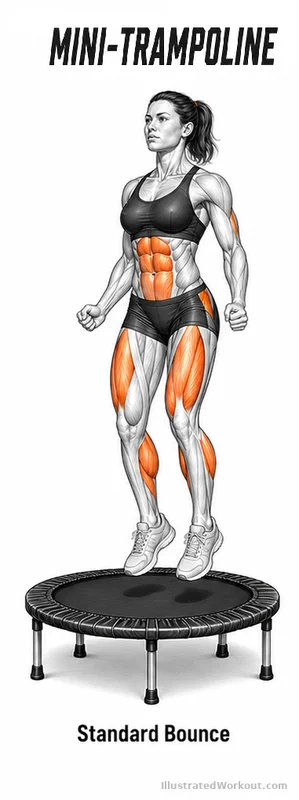
Mini Trampoline Standard Bounce
The foundational rebounder bounce, a light continuous up-and-down on the mat that raises the heart rate with almost no impact on the joints.
Want a mini trampoline conditioning workout?
Our wizard builds one around your time, goal, and equipment in about two minutes. Free — no signup needed.
Make Me a Workout → Just did it? Track your setsThe foundational rebounder bounce, a light continuous up-and-down on the mat that raises the heart rate with almost no impact on the joints.
Level: Beginner
Primary: Cardio
Secondary: Calves
Movement: Isolation
Type: Aerobic (Cardio) Light Activity
Equipment: Mini Trampoline
Target muscles
Absorbing each descent and returning it as the next gentle bounce keeps the calves, ankles and the small muscles of the feet firing constantly, while the quadriceps and glutes stay lightly engaged to hold the knees soft and the hips level. The core maintains an easy upright posture throughout. The stimulus is aerobic and very gentle, making it the easiest way to keep circulation and heart rate up on a rebounder.
How to perform
Setup
Stand in the middle of the mat with feet hip-width, knees soft and arms relaxed by the sides or lightly bent. Bring the weight onto the balls of the feet and let the shoulders sit easy. Brace the trunk gently so the torso stays tall as you settle into the rhythm.
Execution
Begin bouncing lightly, letting the feet stay in contact with or just skim the mat as the surface rebounds you up and down. Keep the bounces low, soft and continuous, absorbing each landing through slightly bent knees. Stay centred over the mat rather than drifting toward the frame, and let the arms move easily if that helps the rhythm. Breathe conversationally and keep the pace comfortable and even. There is no need to leap; the value comes from the steady, relaxed bounce that gently loads the legs and lifts the heart rate.
Common mistakes
- Bouncing too high and turning a gentle rebound into a tiring series of jumps.
- Landing flat and heavy instead of staying soft and springy on the balls of the feet.
- Locking the knees, which removes the shock absorption the bounce depends on.
- Drifting off the centre of the mat where the rebound is uneven and balance falters.
Progressions and regressions
Regress by keeping the feet lightly on the mat in a health-bounce with barely any lift, holding a stability bar until it feels natural. Progress toward a jogging bounce, then high knees or a power bounce as fitness and confidence build. It is also the resting rhythm to return to between harder rebounder intervals.
Programming notes
Use it as a warm-up, a cool-down, or entry-level low-impact cardio, running two to ten minutes at an easy pace. Its gentleness suits beginners, older trainees and anyone rebuilding after injury, since the mat removes nearly all impact. Keep it relaxed and continuous; when you want more challenge, add movement patterns such as knees, jacks or twists rather than simply bouncing harder.