Bear Crawls
Quadrupedal crawl with knees hovering, moving opposite hand and foot in sync — fundamental locomotion and trunk-stability builder.
Level: Beginner
Primary: Cardio Full Body
Movement: Compound
Tags: Animal Movement
Type: Anaerobic Intervals (HIIT / Bootcamp / Circuit) Functional Fitness (Obstacle & Hybrid) Primal Movments (Animal Flow-QMT Specifics)
Equipment: Body Weight
Sports: Gymnastics MMA Wrestling
Target muscles
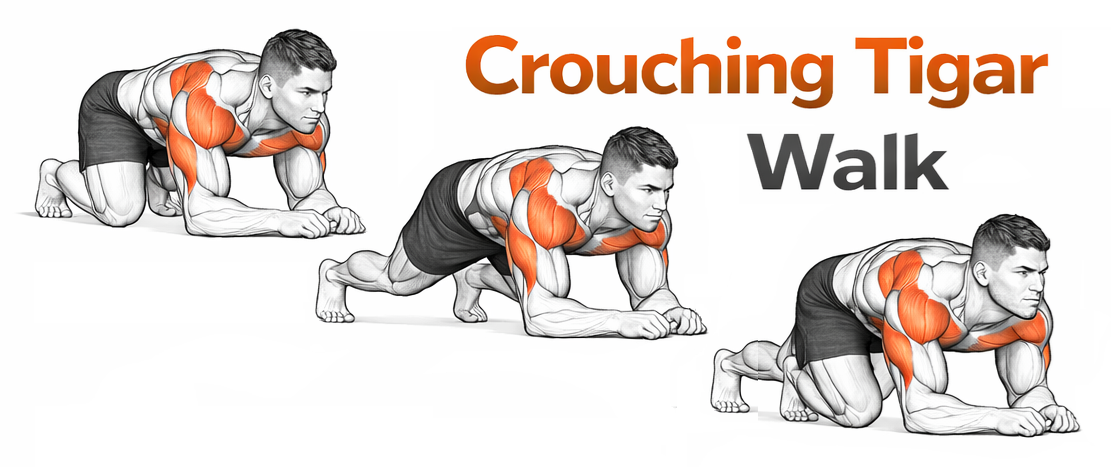
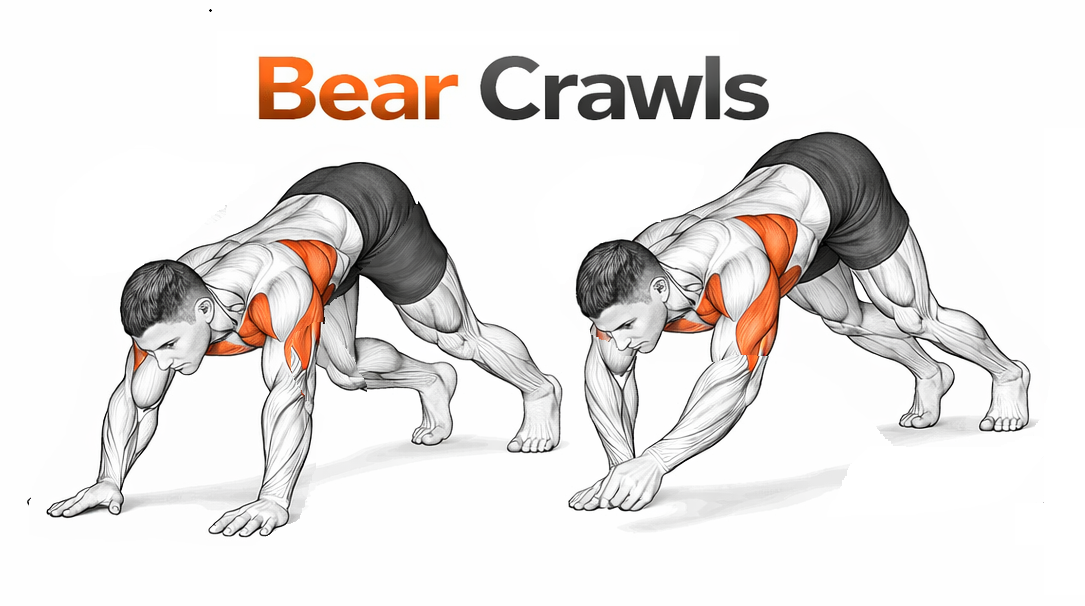
The rectus abdominis and obliques work isometrically to keep the spine neutral against the contralateral movement of arm and leg. The anterior deltoids and serratus anterior stabilize the shoulders under load with every hand strike. The hip flexors and quadriceps drive each knee forward. The glute medius of the planted leg fires to keep the hips from collapsing laterally as the opposite leg moves. Cardiovascular load builds quickly because so much musculature is firing simultaneously — sustained bear crawls turn into a brutal conditioning movement.
How to perform
Setup
Start in a bear-crawl position — hands under shoulders, knees under hips, knees one inch off the floor. Pack the shoulders, brace the trunk. Take a breath.
Execution
Move forward by stepping the opposite hand and foot simultaneously — right hand and left foot, then left hand and right foot. The knees stay hovering one inch off the floor through every step. The hips stay level with the shoulders; the spine stays flat. Move at a controlled pace that lets you breathe. Continue forward for the prescribed distance or time, then either reverse direction or stop. Faster bear crawls become more cardio; slower bear crawls become more trunk-control work.
Common mistakes
- Knees rising too high or coming back down to the floor between steps. The one-inch hover is non-negotiable; that's what makes it a bear crawl rather than a regular crawl.
- Hips sticking up into a downward-dog shape. Hips stay level with the shoulders.
- Same-side hand and foot moving together. The cross-pattern (opposite hand and foot) is the trunk-training piece.
- Holding the breath through every set. Breathe in controlled cycles, exhale on every other step.
- Moving too fast. Speed loses the trunk control; if the spine starts swinging or the hips rotating, slow down.
Progressions and regressions
Regress to the bear crawl hold (static position only) until the position is stable. Then add a few steps at a time. To progress, walk faster, walk backward, walk laterally, or chain with other primal movements (bear-to-crab transitions, ape walks). Weighted bear crawls (weighted vest, plate on the lower back) add load without changing the pattern.
Programming notes
Excellent dynamic warm-up (one set forward and back across the gym), conditioning movement (30-60 seconds per round in intervals), or trunk finisher (3 sets of 20-meter forward and back). Two or three times a week. The cumulative demand on the wrists and shoulders is real if you do these every day — alternate with other locomotor patterns for joint variety.