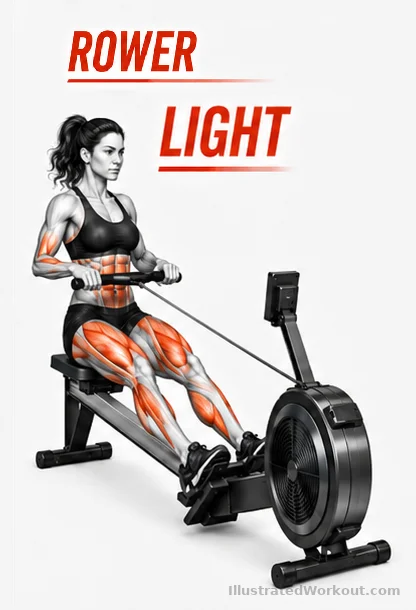
Rower Light
Easy rowing at a low stroke rate that grooves the leg-back-arm sequence while keeping the breath relaxed and conversational.
Want a rower conditioning workout?
Our wizard builds one around your time, goal, and equipment in about two minutes. Free — no signup needed.
Make Me a Workout → Just did it? Track your setsEasy rowing at a low stroke rate that grooves the leg-back-arm sequence while keeping the breath relaxed and conversational.
Level: Beginner
Primary: Cardio
Secondary: Back - Upper Hamstrings Quads
Movement: Compound
Type: Aerobic (Cardio) Light Activity
Equipment: Rower
Target muscles
Even at an easy pace, rowing is a whole-body chain: the quadriceps and glutes start each drive by pressing the seat back, the hamstrings assist as the hips open, and the upper back, lats and biceps finish the pull as the handle comes to the ribs. The core braces to link the two ends of the stroke. Kept gentle, none of these muscles is taxed heavily; the aim is smooth technique and light circulation rather than hard conditioning.
How to perform
Setup
Strap the feet in with the strap across the ball of the foot, and take a relaxed overhand grip on the handle. Sit tall at the catch with the shins vertical, arms straight and shoulders in front of the hips. Set the damper to a low or moderate setting so each stroke feels light, and plan to keep the stroke rate slow and unhurried.
Execution
Drive in sequence: press with the legs first, then swing the torso open from the hips, and finally draw the handle to the lower ribs with the arms. Reverse the order on the recovery, extending the arms, hinging forward, then bending the knees to slide up to the catch. Keep the effort down at a three or four out of ten, an easy pace where you could chat comfortably, and let the recovery slide be slower than the drive. Breathe naturally and evenly, and prioritise a clean, connected stroke over speed for the whole duration.
Common mistakes
- Breaking the sequence by yanking with the arms before the legs have driven, which disconnects the stroke.
- Rounding the lower back at the catch instead of hinging forward from the hips with a tall spine.
- Rushing the recovery slide so it matches the drive, which spikes the effort above an easy pace.
- Cranking the damper high and hauling hard, turning a light session into unnecessary grind.
Progressions and regressions
Regress by slowing the stroke rate further, shortening the piece, or drilling the leg-body-arms sequence in slow segments to learn the timing. Progress by lifting the stroke rate and effort toward a Rower Moderate pace, adding a little damper, or extending the distance. Interval bursts build toward Rower Sprint work once the technique is grooved and reliable.
Programming notes
Program it as a warm-up, a cool-down, or easy active recovery for five to twenty minutes, and as the ideal setting for a newcomer to learn the rowing stroke without fatigue clouding technique. The low-impact, full-body nature makes it kind to the joints while still moving a lot of muscle. Keep it genuinely light; its purpose is clean technique and gentle blood flow, not a taxing effort, so save the hard pulling for the moderate and sprint versions.