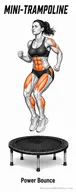
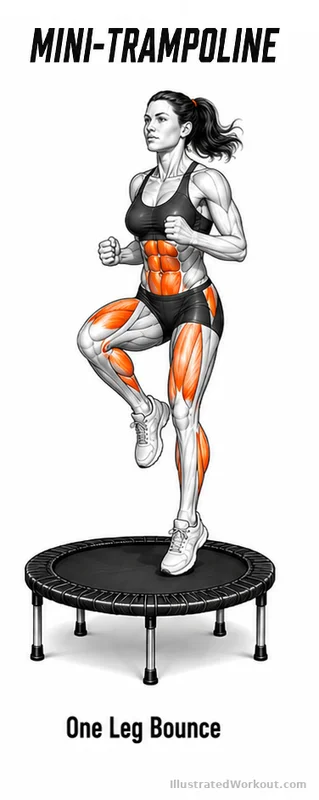
Mini Trampoline One Leg Bounce
A single-leg rebound that bounces on one foot at a time, challenging balance and ankle stability while keeping the heart rate up.
Want a mini trampoline conditioning workout?
Our wizard builds one around your time, goal, and equipment in about two minutes. Free — no signup needed.
Make Me a Workout → Just did it? Track your setsA single-leg rebound that bounces on one foot at a time, challenging balance and ankle stability while keeping the heart rate up.
Level: Foundation
Primary: Cardio
Secondary: Calves Glutes
Movement: Isolation
Tags: Balance / Stability Unilateral
Type: Aerobic (Cardio)
Equipment: Mini Trampoline
Target muscles
Balancing on one leg loads the calf, ankle stabilisers and the small foot muscles heavily as they control every rebound, while the glute and hip abductors of the standing leg fight to keep the pelvis level. The quadriceps stabilise the knee and the core braces to stop the torso tipping. Alternating legs keeps the cardiovascular demand steady, but the standout stimulus here is single-leg balance and the reactive strength of the lower leg.
How to perform
Setup
Stand over the centre of the mat and shift your weight onto one foot, lifting the other just off the surface. Soften the standing knee and set the weight over the mid-foot. Brace the core and fix your gaze on a point ahead to steady the balance before you begin.
Execution
Bounce gently on the single standing leg, keeping the hops low and controlled as the mat rebounds you. Let the calf and foot manage each landing while the glute holds the hip from dropping to the side. Keep the raised foot quiet and the torso tall, resisting any wobble with a firm brace rather than flailing the arms. Perform a set number of bounces or a timed spell, then switch legs and repeat evenly on the other side. Prioritise control and a level pelvis over height or speed throughout.
Common mistakes
- Letting the hip of the standing leg drop, which means the glute has stopped stabilising the pelvis.
- Bouncing too high and losing control of the landing on a single, unstable base.
- Flailing the arms to catch balance instead of bracing the core to stay steady.
- Spending unequal time on each leg, building an imbalance between sides.
Progressions and regressions
Regress by holding a stability bar or lightly touching the raised toe down between bounces for support. Progress by taking the hand off the bar, closing the eyes briefly, raising the bounce height, or holding the non-standing knee up to increase the balance challenge. Adding a small forward or sideways reach with the free leg tests stability further.
Programming notes
Program it as a balance and ankle-stability drill within a rebounder circuit or a warm-up, twenty to thirty seconds per leg or a set count each side. It suits general fitness, rehab and older trainees working on single-leg control. Always match the work on both sides, and use a support bar early on, since the single-leg base makes a mistimed landing easy near the frame.