Cat Crawl
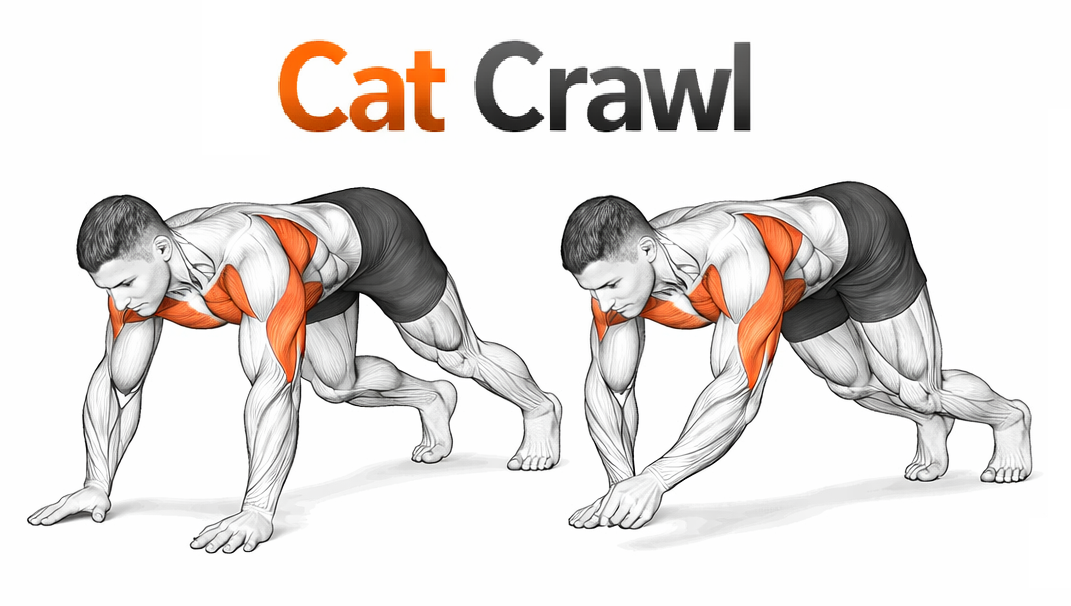
Slow forward crawl with a rounded spine and low hips — animal-flow movement that builds trunk awareness and shoulder control.
Level: Beginner
Primary: Cardio Full Body
Movement: Compound
Tags: Animal Movement
Type: Functional Fitness (Obstacle & Hybrid) Primal Movments (Animal Flow-QMT Specifics)
Equipment: Body Weight
Sports: Gymnastics MMA Wrestling
Target muscles
The trunk muscles — rectus abdominis, obliques, deep core — fire continuously to hold spinal flexion while the limbs move beneath you. The serratus anterior packs the scapulae against the ribcage as the hands cycle. The hip flexors lift each knee, then the gluteus medius of the planted leg stabilizes the hip during single-leg loading. Shoulders, triceps, and chest work isometrically to support the slow weight transfer. Cardiovascularly modest at slow pace, but the trunk endurance demand grows fast once the set passes thirty seconds.
How to perform
Setup
Start on all fours — hands under shoulders, knees under hips. Round the upper back slightly toward the ceiling (think gentle cat-cow position, but stopped at the top of the cat). The knees hover just above the floor. The spine stays in mild flexion through the entire crawl.
Execution
Move forward by stepping opposite hand and opposite foot simultaneously — right hand and left foot move together, then left hand and right foot. The knees stay one inch off the floor through every step. Move slowly and deliberately; this isn't a sprint crawl. Keep the back rounded, not flat — that's the "cat" piece. Breathe through the nose in controlled cycles. Continue for the prescribed distance or time.
Common mistakes
- Letting the back flatten or arch into extension. The cat crawl keeps the spine in mild flexion throughout — that's what differentiates it from a bear crawl.
- Moving fast. Speed loses the trunk-control benefit; if your form looks sloppy, slow down to half speed.
- Knees touching the floor between steps. The hover is non-negotiable.
- Same-side limbs moving together. The cross-pattern (opposite hand and foot) trains the trunk's anti-rotation.
- Holding the breath. Breathe in slow controlled cycles.
Progressions and regressions
Regress to the bear crawl hold (static) until you can hold the position for thirty seconds. To progress, work the cat crawl across longer distances, alternate cat-crawl with bear-crawl direction changes, or chain with other primal movements (cat crawl into a beast-to-crab transition).
Programming notes
Useful warm-up movement (one or two slow passes across the gym) or animal-flow conditioning piece (30-60 seconds per round, 4-6 rounds). Two or three times a week. The wrist load adds up over high volume; alternate with other locomotor patterns to give the wrists rest days. Pair with lateral animal walks for full primal-movement variety.