Mini Trampoline Boxer Shuffle
A light bouncing shuffle borrowed from boxing footwork, keeping a steady rebound rhythm on the mat to build cardio without pounding the joints.
Want a mini trampoline conditioning workout?
Our wizard builds one around your time, goal, and equipment in about two minutes. Free — no signup needed.
Make Me a Workout → Just did it? Track your setsA light bouncing shuffle borrowed from boxing footwork, keeping a steady rebound rhythm on the mat to build cardio without pounding the joints.
Level: Foundation
Primary: Cardio
Secondary: Calves Quads
Movement: Isolation
Type: Aerobic (Cardio)
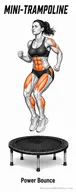
Equipment: Mini Trampoline
Target muscles
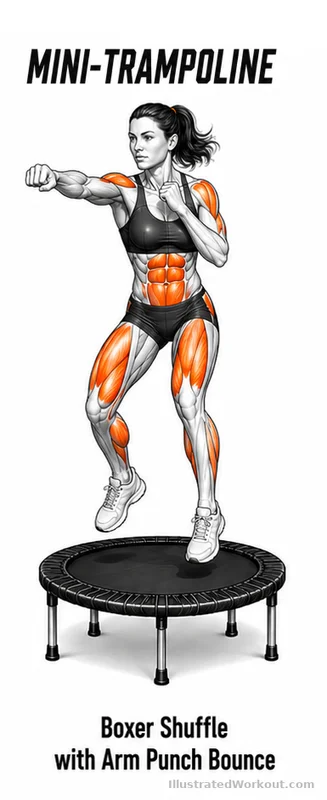
The calves and ankle stabilisers do the constant, springy work, absorbing each contact with the mat and returning it as the next small hop. The quadriceps and glutes stay lightly engaged to keep the knees soft and the hips level, while the core holds an upright boxing posture. Because the feet never stop moving, the cardiovascular system carries the real load and the heart rate settles into a comfortable steady zone.
How to perform
Setup
Stand near the centre of the mat with feet hip-width, knees soft and weight over the balls of the feet. Raise the hands into a loose guard by the chin and tuck the elbows to the ribs. Brace the trunk gently so the chest stays tall and the shoulders sit relaxed rather than hunched.
Execution
Shift your weight lightly from foot to foot in a small, quick shuffle, letting the mat rebound each step so the feet barely leave the surface. Keep the contacts soft and even, staying over the centre of the mat rather than drifting toward the frame. Breathe in an easy rhythm and let the arms bob gently in time with the feet, as a boxer would while circling. Hold the cadence relaxed and continuous for the working interval, keeping the knees bent and the landings quiet the whole time.
Common mistakes
- Drifting off the centre of the mat toward the frame, where the rebound is uneven and less forgiving.
- Locking the knees, which turns a soft shuffle into a jarring series of flat-footed stamps.
- Hunching the shoulders up around a tense guard instead of staying tall and loose.
- Bouncing too high, which breaks the quick, low shuffle rhythm the drill depends on.
Progressions and regressions
Regress by slowing the tempo to a gentle weight-shift with barely any lift, using a stability bar for confidence. Progress by adding light shadow-boxing punches on the shuffle, quickening the footwork, or alternating thirty seconds of shuffle with thirty of higher-knee bouncing to lift the intensity.
Programming notes
Use it as a low-impact warm-up or an active-recovery station between harder efforts, running two to four minutes at an easy conversational pace. It suits deconditioned trainees and anyone protecting sore knees, since the mat soaks up the impact. Keep it steady rather than maximal; it is a rhythm and circulation drill, not a finisher, so pair it with more intense stations if you want a real conditioning spike.