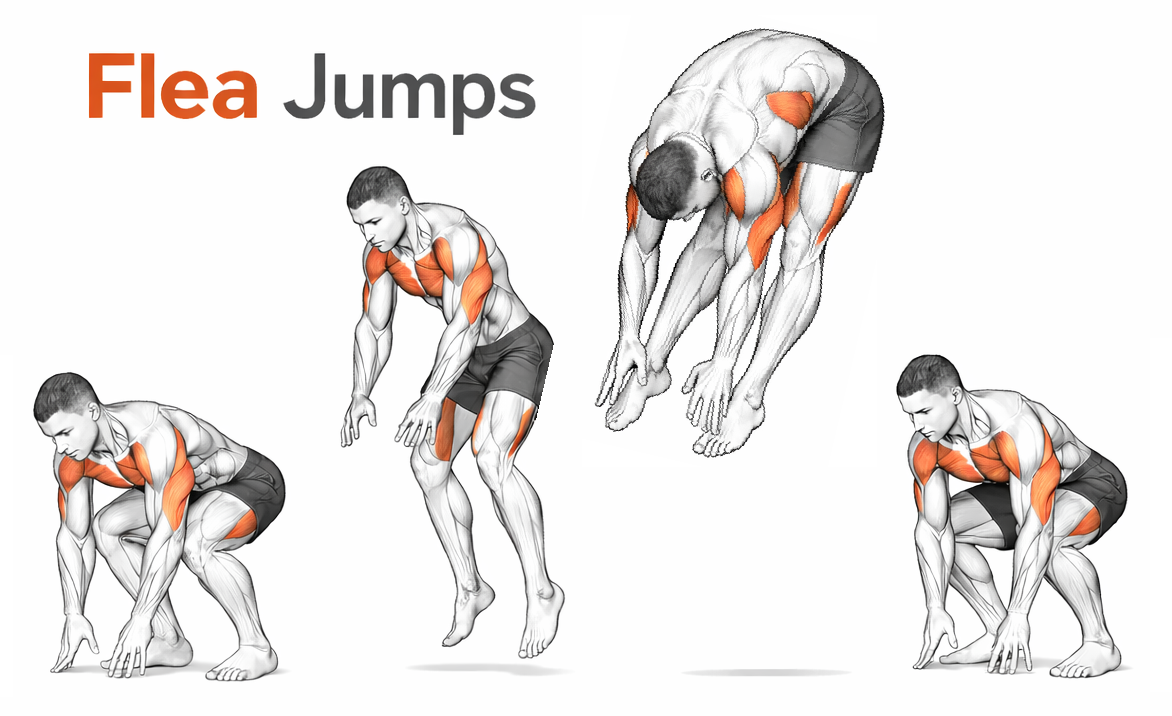
Flea Jumps
Rapid small-amplitude pogo hops staying on the balls of the feet — pure ankle and Achilles reactive work.
Level: Foundation
Primary: Cardio
Movement: Compound
Tags: Animal Movement Explosive
Type: Plyometric Primal Movments (Animal Flow-QMT Specifics)
Equipment: Body Weight
Sports: Basketball Volleyball
Target muscles
The calves — gastrocnemius and soleus — and the Achilles tendons drive the rapid bounces. The intrinsic foot muscles control foot position. The quadriceps and gluteus maximus contribute lightly; the deeper hip and knee musculature is suppressed because the ankles do nearly all the work. As pure reactive-strength training goes, this is one of the most direct movements for ankle stiffness and elastic-energy return.
How to perform
Setup
Stand with feet together. The knees have only a slight bend — they barely move. Arms relaxed. Eyes forward.
Execution
Hop straight up off the balls of the feet — small amplitude, rapid rhythm. The bounce comes from ankle stiffness and elastic recoil; no real knee or hip movement. Land mid-foot or on the balls of the feet, then immediately bounce again. Ground contact time should be as brief as possible. Continue for the prescribed time or rep count.
Common mistakes
- Bending the knees on each landing. The knees stay nearly locked.
- Landing on the heels. Mid-foot or ball-of-foot only.
- Pumping the hips up and down. Hips stay quiet.
- Going too long without rest. After 20-30 seconds the elastic quality degrades.
- Doing high volume on hard surfaces.
Progressions and regressions
Regress to short calf raises and slow ankle hops until the elastic quality is established. To progress, work single-leg flea jumps, lateral flea jumps, or chain with broad jumps for plyometric sequences.
Programming notes
Excellent low-volume plyometric. 3-4 sets of 15-30 seconds with full recovery, twice a week. The Achilles tendon load is significant; back off if calf tightness persists.