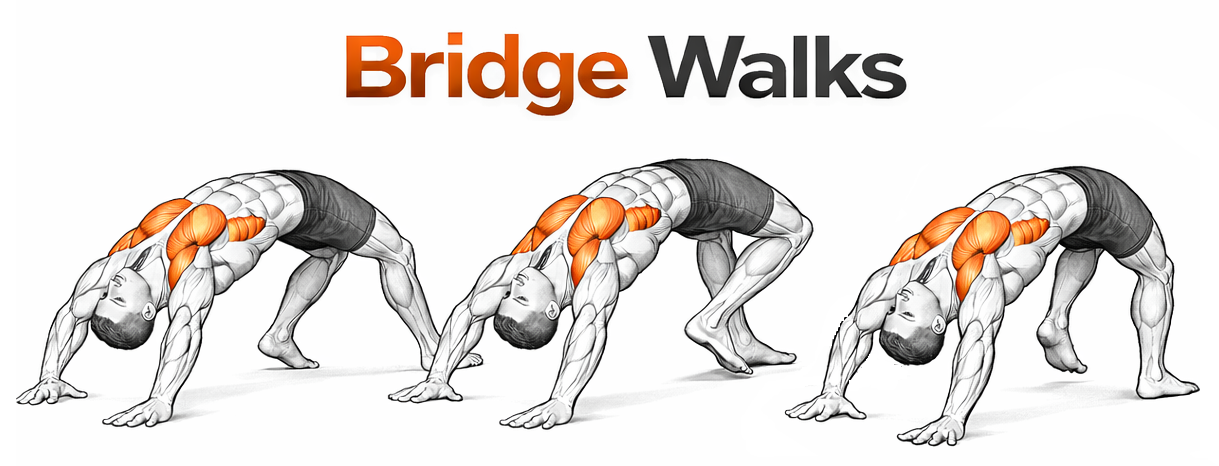
Bridge Walks
Walk your feet away from your hips while holding a glute bridge — long-range hamstring and glute endurance work with high trunk demand.
Level: Foundation
Primary: Cardio Full Body
Movement: Compound
Type: Flexibility (Dynamic Stretching) Functional Fitness (Obstacle & Hybrid) Light Activity
Equipment: Body Weight
Sports: Gymnastics MMA Wrestling
Target muscles
The gluteus maximus holds the hip extension under increasing lever as the feet walk away from the body. The hamstrings work harder as the leg lever lengthens — they're being asked to hold knee position with the load further from the hip. The spinal erectors brace continuously to keep the lumbar from collapsing. The trunk works isometrically against the constantly-changing leverage. The shoulders and triceps press the upper back into the floor to support the bridge. By the time the feet are at full extension, this is more of an isometric than a dynamic movement.
How to perform
Setup
Set up as for a standard glute bridge: lying on your back, knees bent, feet flat and hip-width apart, heels close to the hips. Lift the hips into a bridge position — straight line from shoulders to knees. Brace the trunk. Squeeze the glutes.
Execution
Walk the feet forward away from the hips one step at a time, keeping the hips elevated and the trunk braced throughout. With each step, the hip extension shortens and the load on the hamstrings and trunk increases. Go as far as you can while keeping the hips raised at body line; the moment the hips drop, the working set is over. Walk the feet back to the start. Some programs prescribe a fixed number of steps; others go for time or distance.
Common mistakes
- Letting the hips drop as the feet walk further out. The hips stay at body-line height; if they sag, stop the walk and return.
- Pushing off with the toes instead of the heels. Each step is a heel walk; the front of the foot just stabilizes.
- Arching the lower back as fatigue builds. Brace and tuck the ribs — if the back arches, the glutes have stopped working.
- Walking too fast. Slow controlled steps; the trunk needs time to adjust to each new leverage.
- Bouncing the hips up and down to maintain height. The hips should stay quiet; the feet do the walking.
Progressions and regressions
Regress to the static glute bridge (no walking) held for 30-60 seconds until the position is solid. To progress, walk further out, add a tempo (3-second pause at each step), or work the single-leg bridge walk for a serious hamstring and glute endurance challenge.
Programming notes
Excellent finisher after lower-body sessions or as accessory hamstring work in a leg day. 3-4 sets of 8-12 step-pairs (walk out + walk back counts as one rep), two to three times a week. The trunk demand limits how heavy you can make this without losing position; pure bodyweight is usually enough. Pair with Nordic curls and Romanian deadlifts for a complete hamstring program.